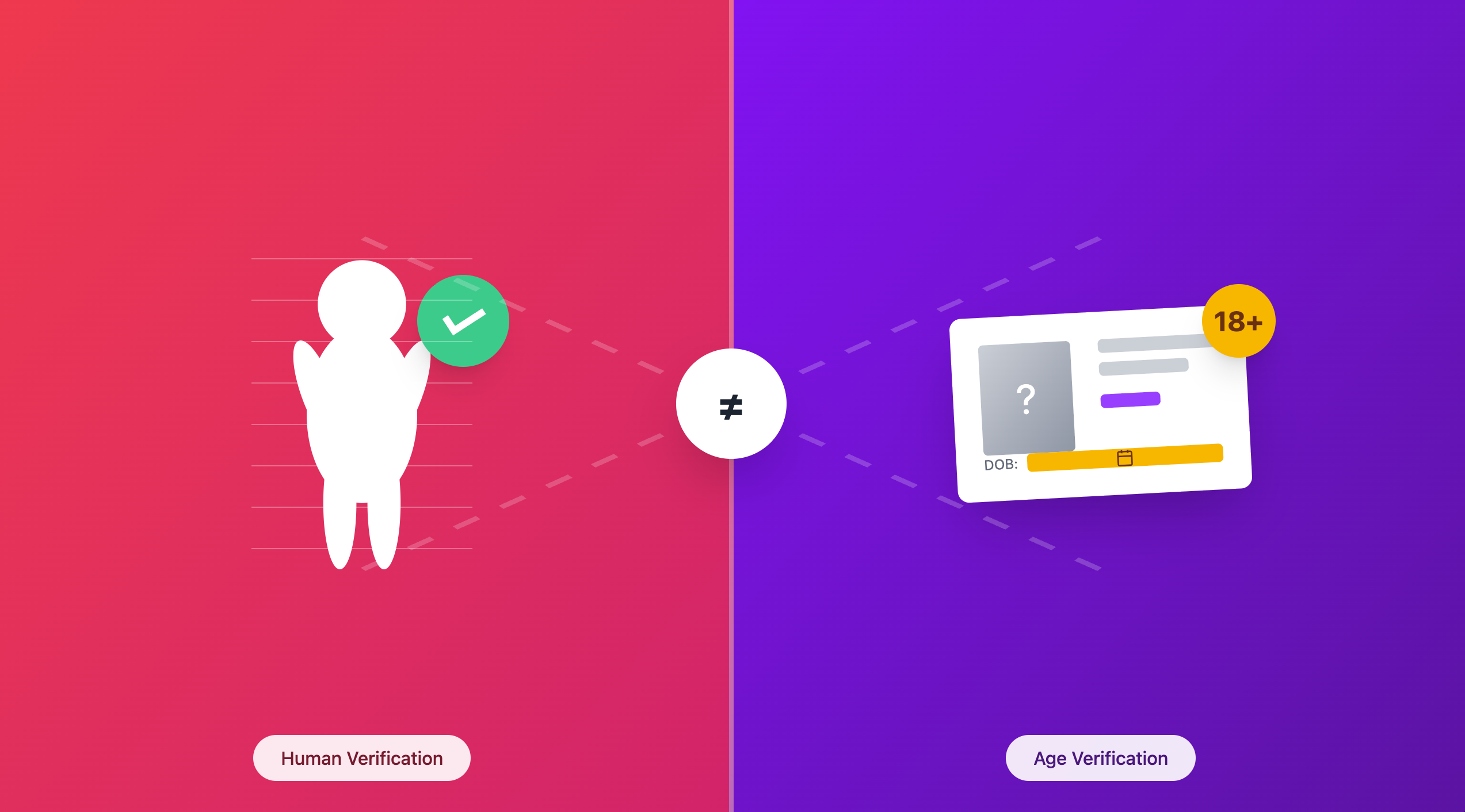
Human Verification vs. Age Verification: They're Solving Different Problems
Two different questions, two different tools. Conflating them is how you end up with bad policy, annoyed users, and a pile of government IDs stored somewhere you'd rather not think about.
Ammar Khan
There's a lot of confusion in the market right now about what "verification" actually means online, and that confusion is doing real damage. Legislators, platforms, and product teams reach for the word as if it describes a single category of problem with a single category of solution. It doesn't. Age verification and human verification are answering entirely different questions, and treating them as interchangeable is how you end up with invasive infrastructure built for the wrong job.
The distinction matters more than ever right now, because both categories are accelerating fast. Half of all U.S. states now mandate some form of age gating for adult content or social media access, with more laws taking effect in 2026, and courts are actively working out where the constitutional lines are. (Online and On Point) Meanwhile, the bot problem: synthetic respondents, fake accounts, automated fraud at scale has reached a level of sophistication that makes most current defenses look like they were designed for a different era. The policy conversation and the product conversation need to be happening separately, because confusing them produces systems that solve neither problem particularly well.
What Age Verification Is Trying to Do
Age verification has a specific, legally-driven purpose: confirm that a user clears a particular age threshold before accessing restricted content or services. Alcohol, gambling, adult content, and increasingly social media platforms all sit in this category, and the regulatory wave of the last few years has hardened it from a voluntary practice into a compliance obligation in many jurisdictions.
The technical approaches vary widely, and each one involves real tradeoffs. The most direct method is document-based verification, uploading a government-issued photo ID to a third-party service that confirms the user is over 18. It provides a high degree of certainty, and it creates a record of sensitive personal data sitting somewhere in someone else's infrastructure. When AU10TIX and Discord both faced high-profile data breaches exposing user verification data for months or years, this was the vulnerability pattern at work. (EFF) The World Bank estimates that around 850 million people globally lack government-issued documentation, which means document-based systems structurally exclude a significant population before they even get to the content question. (Ondato)
Facial age estimation has emerged as a more friction-friendly alternative, analyzing a selfie to estimate whether the user clears a threshold without requiring document upload. Meta deployed it on Instagram in multiple markets through third-party partners, and when the system flags a user as possibly underage, it prompts a video selfie for further review. Appeals frequently trigger additional checks, and misclassification is common enough to be a recurring user complaint. (IEEE Spectrum) The Electronic Frontier Foundation has documented systematic failure rates for people of color, trans individuals, and people with disabilities, for whom facial analysis performs least reliably. (Center for Democracy and Technology)
The self-declaration method, where you enter a birthdate or check a box, is still widespread despite decades of evidence that it catches essentially nothing. Florida saw VPN demand surge 1,150% after its age verification law took effect, which captures the behavioral reality: people route around friction rather than comply with it. (EFF) The law creates the appearance of enforcement while routing legitimate users through annoyance and determined users through a VPN.
What Human Verification Is Trying to Do
Human verification is answering a categorically different question: is there a real, unique person behind this account, regardless of who they are or how old they are? Age is irrelevant to this question. Identity documents are irrelevant to this question. The only thing that matters is whether the entity on the other side of the interaction is a genuine human, not a bot, not a synthetic respondent, not a coordinated farm of automated accounts claiming to be people.
The scale of the problem it's addressing has gotten substantially harder to dismiss. A Dartmouth researcher built an autonomous AI from a 500-word prompt, ran it through 43,000 survey attempts, and watched it pass 99.8% of attention checks designed to catch automated responses, while calibrating its answers to match whatever demographic profile it had been assigned, and strategically declining to answer questions designed to expose superhuman capabilities. (PNAS via phys.org) Quantic Foundry documented the coordinated "farm" model, where a human vanguard maps a survey's screening criteria and trap questions, then hands off to automated systems that exploit that knowledge at volume. (Quantic Foundry) Neither of these threats has anything to do with age. A 35-year-old bot is still a bot.
The commercial ecosystem around automated fraud has grown in direct proportion to how much of the internet runs on user-generated behavior. Surveys, reviews, social accounts, AI training labels, presale queues, poll responses: all of these carry financial or informational value, which means there's consistent economic incentive to fake participation at scale. The question human verification is asking, whether this is a real person, is more fundamental than any age or demographic attribute, because it's the precondition for any downstream data meaning anything at all.
Why Conflating Them Creates Problems
The policy confusion around age verification has produced systems that are more invasive than they need to be, partly because legislators and platforms keep reaching for the most document-heavy solution available on the assumption that it signals seriousness. But the document-heavy approach to age confirmation collects and stores sensitive personal information to answer a question that could often be answered more narrowly. And that data gets breached. And the users who get hurt are disproportionately the ones the system was ostensibly trying to protect.
The product confusion runs in the other direction. Platforms that want to address bot infiltration and synthetic account fraud sometimes reach for age-verification-style solutions, collecting government documents or running facial scans, when the actual question they're trying to answer has nothing to do with age. You don't need to know how old a person is to confirm they're a person. Asking for more information than the problem requires is a liability decision as much as it is a user experience problem.
There's also a structural issue with how both categories of verification are deployed. Age verification, in most current implementations, happens once at account creation and then never again. Human verification needs to be understood as something different: not a one-time gate, but a durable credential that travels with a user across contexts, so that the confirmation of humanness established at verification doesn't need to be re-established at every touchpoint. The friction model for age verification and human verification should look completely different, because the frequency of use is completely different.
What the Verification Stack Actually Looks Like
The emerging picture is that platforms need to answer multiple distinct questions about their users, and conflating those questions into a single verification moment creates a system that handles all of them poorly. Whether this person is old enough to access this content, whether this is a real unique human, whether this person has consented to this specific use of their data, whether this is the same person who verified last time — these are different questions with different answers requiring different tools.
The human verification layer is the most foundational, because it's the one that makes the others meaningful. Age confirmation for a fake account is useless. Consent from a synthetic respondent is noise. The value of any downstream verification attribute depends entirely on there being a real human attached to it.
Verified human status, established once and carried forward as a credential, changes the architecture of how trust gets built online. Rather than re-interrogating users at every gate, the credential does the work. That's the difference between a security model built around catching suspicious behavior and one built around confirming authentic participation. The first is a game the attacker can always study and optimize against. The second sets a floor that's categorically harder to fake at scale.
The internet needs both kinds of verification to work well. What it can do without is treating them as the same thing.\
0 to IPO: What VerifyYou Co-Founder and Former Reddit CTO Learned Scaling Through the Chaos
Why CAPTCHA Is Broken (And What Comes After It)