In a peer-reviewed study, an AI agent posing as a survey respondent passed 99.8% of standard attention checks across 6,000 trials.
Sean J. Westwood, Dartmouth, "The potential existential threat of large language models to online survey research", PNAS, Vol. 122 No. 47, November 2025Market research
A respondent clears the attention check.The face behind it still has to be new.
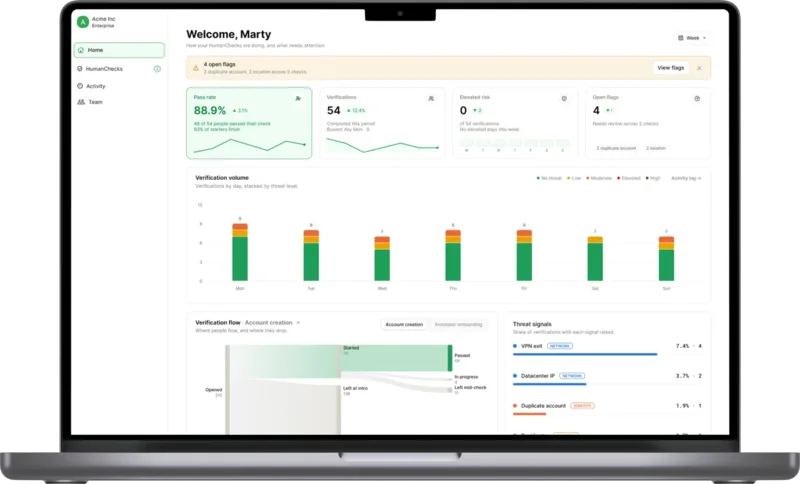
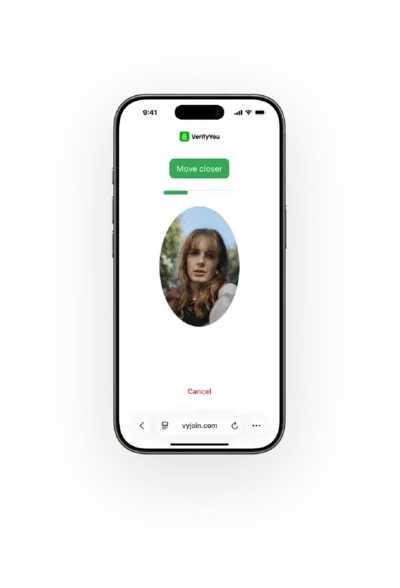
Every respondent is scored quietly, and a 3 second anonymous selfie, when you choose, confirms one real person.
The problem
The fraud your quality checks miss
- j•••@gmail.comjm•••@proton.mej.m•••@yahoo.comSame person
The duplicate respondent
One person farms a stack of email accounts and fills the same survey under each, and a new device makes them look new again.
- Attention checkSomewhat agreeSelect "Somewhat agree"PassedAI agentNo face
The synthetic respondent
An AI agent takes the survey, clears the attention checks and writes open ends that read fine.
- 600 bought · 500 kept100 thrown out
Buying 600 to keep 500
Teams over-order sample to cover the completes they expect to throw out after fielding.
Why 40% of Survey Data Gets Rejected Post-Field · 1:43
What changes
Real respondents answer once. The duplicates don't get a second try.
01
Passive signals score every respondent
Network, device and behavior signals run in the background and build each respondent's history: past scores and how many surveys they've started today. Across our network, that history catches repeat fraud early.
02
Risky respondents take a face check
When the signals flag risk, a 3 second selfie confirms a live, unique person before the first question loads. Good respondents never see it.
03
Inside the survey tool you use
A one-time passcode, created for one verified face and used once, goes into the survey platform you already field on. With code, it's two API calls.
Respondent 55219 surveys started todayElevated
The platform
Passive defenses first, proof of human when it counts.
Why now
Bots now pass attention checks
"AI becomes a force for good. It helps prevent AI-driven fraud."
Wes Michael, Founder of Rare Patient Voice





A solution for every scenario
Let's talk trust
Start with a free pilot: see what the check catches on your own users, with no dev work to begin.
With tools like VerifyYou, AI becomes a force for good. It helps prevent AI-driven fraud and can be done with much lower friction than what we built over the years.
Built by humans from
- Quora
- Square
- Gusto
- Cohere Health
- Accenture
Security
Privacy and security in every decision
We keep a face code, not the photo, and hold it under SOC 2 Type II and ISO 27001:2022 compliant controls.
No images stored. VerifyYou does not store images.
No ID or documents. HumanCheck anonymously confirms there is a real, live, unique person, with no name or ID.
A face code, not a photo. We treat it as sensitive biometric data.
 SOC 2 Type II
 ISO 27001:2022
 ISO/IEC 30107-3 PAD Level 1 & 2
 GDPR compliant
Common questions
How does survey fraud detection work with VerifyYou?
Most survey fraud detection scores the answers after field. VerifyYou checks the respondent before the first question: passive signals score every session, and when they flag risk an anonymous HumanCheck of about 3 seconds confirms a live, unique person, so one person can't take the same survey twice under different panel accounts.
Will it hurt completion?
You decide who sees the check and when: at the survey entrance, at the payout, or only for respondents your signals flag. The anonymous HumanCheck is designed to keep drop-off low. A free pilot lets you measure it on your own traffic.
Does it work with the fraud tools we already use?
Yes. Most teams keep what they already run and add HumanCheck as the active, anonymous layer on top. Fingerprinting and scoring tools look at the device and the answers, and HumanCheck anonymously checks the person.
We buy sample from several suppliers. Can it catch the same person across them?
Yes, when the check runs in your workspace. Duplicates are judged inside your own respondent base, so a person who arrives from two suppliers matches the face already on record. Scope uniqueness to a single study or project and each person takes part once in it, then again in the next. Separately, if a person has been flagged elsewhere in our network, you get an anonymous signal. We never say which platform.
Can it check age or location for quotas?
The same selfie can return an estimated age range, and you choose which signals to collect. An age range is an estimate, not legal proof of age. Location comes from network signals, not the phone's GPS, and flags VPNs and data center traffic.
Won't passive signals alone catch this?
They cut both ways. The same network checks that flag a fraudster on a VPN also flag a real respondent working from a corporate VPN or a data center, and a passive-only tool can wrongly block that person. An anonymous HumanCheck gives a flagged respondent a direct way to confirm they're live and unique, instead of losing a good panelist to an inference.
Do you store photos of our users?
No. We keep a face code, not your users' images.
How much work is it to add?
It's two API calls: one to start the check and one to read the result.
What does it cost?
It's 50 to 100 times cheaper than KYC. You pay per check, and nobody uploads an ID document.
Resources
Keep learning
Blog
How to Know If Your Survey Panel Has a Bot Problem
The bad data looks exactly like the good data. That's the whole problem.
Read the post
Blog
Every Extra Step Costs You a Respondent
Verification protects your sample. It also thins it. Frictionless reverification is how research teams stop choosing between the two.
Read the post- (opens in a new tab)

White paper
The Human Data Premium
The market research white paper · 14 min read
Read the PDF
Ready to get started?
VerifyYou scales trust: passive signals on every session, a face check only when risk calls for it.