In a peer-reviewed study, an AI agent posing as a survey respondent passed 99.8% of standard attention checks across 6,000 trials.
Sean J. Westwood, Dartmouth, "The potential existential threat of large language models to online survey research", PNAS, Vol. 122 No. 47, November 2025Data quality
You pay for every complete.Pay only for the real ones.
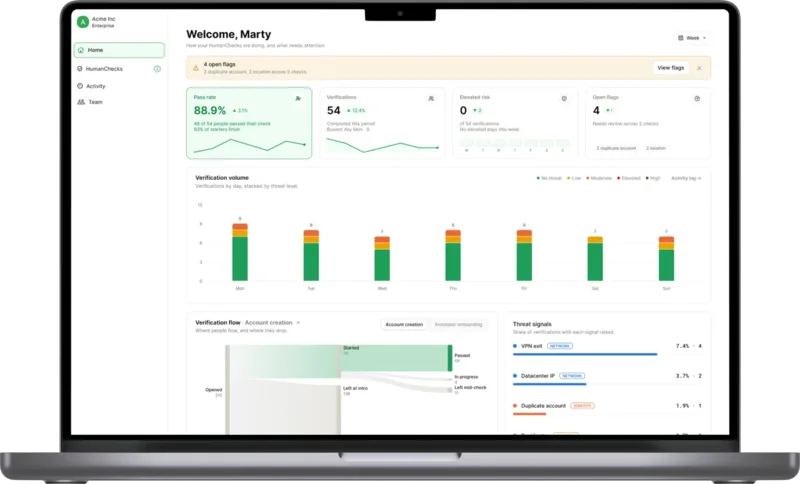
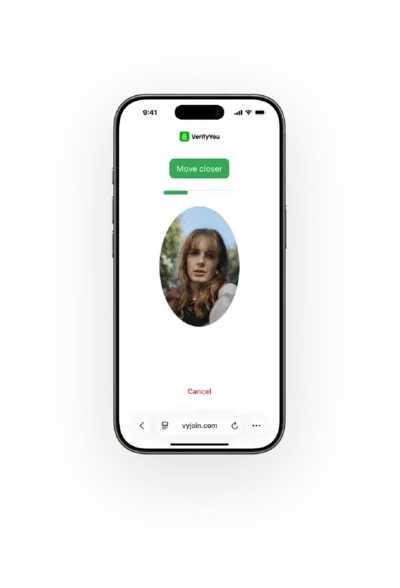
Most respondents and annotators never see a selfie. Background signals score them automatically, and only the ones that don't clear, or that you flag yourself, get a 3 second check confirming a live, unique person, no ID.
The problem
Your checks grade the answer. Nobody checks the hand that typed it.
Attention checks and open-end review judge the answers. None of them check that a live, unique person gave them.
- AI agentLabel reviewBounding box, image 4821Accuracy98%Time on task4.2sPassed
The synthetic respondent
An AI agent takes the survey or the task, clears the attention checks and writes answers that read just fine.
- Different personVerified Mar 3Today's task
The rented account
A vetted worker sells or hands off their login, and the tasks keep coming in under a name that isn't doing them.
- Paid twicePanel BPanel A
The same person, a new panel
One respondent joins through a second panel or a fresh email and gets paid twice for work they've already done.
Why 40% of Survey Data Gets Rejected Post-Field · 1:43
How it works
Clean data, with no friction for real contributors
01
Passive signals score every contributor
Device, network and behavior signals run in the background and build a history for every respondent or annotator: past scores, surveys started, tasks picked up today.
02
Risky contributors take an anonymous face check
When the signals flag risk, a 3 second selfie confirms a live, unique person before the task starts or the payout goes out. Good contributors never see it.
03
Into the tools you already use
A one-time passcode, created for one verified face, drops into the survey tool you field on today with no code. Anywhere else, it's two API calls.
Contributor 8841
Score todayElevated
Last 30 days
Tasks picked up today14
The platform
Passive defenses first, proof of human when it counts.
Why now
Bots now pass attention checks
"AI becomes a force for good. It helps prevent AI-driven fraud."
Wes Michael, Founder of Rare Patient Voice



A solution for every scenario
Let's talk trust
Start with a free pilot: see what the check catches on your own users, with no dev work to begin.
With tools like VerifyYou, AI becomes a force for good. It helps prevent AI-driven fraud and can be done with much lower friction than what we built over the years.
Built by humans from
- Quora
- Square
- Gusto
- Cohere Health
- Accenture
Security
Privacy and security in every decision
We keep a face code, not the photo, and hold it under SOC 2 Type II and ISO 27001:2022 compliant controls.
No images stored. VerifyYou does not store images.
No ID or documents. HumanCheck anonymously confirms there is a real, live, unique person, with no name or ID.
A face code, not a photo. We treat it as sensitive biometric data.
 SOC 2 Type II
 ISO 27001:2022
 ISO/IEC 30107-3 PAD Level 1 & 2
 GDPR compliant
Common questions
Can't our attention checks catch AI respondents?
Less often than they used to. In a study published in PNAS in November 2025, Sean Westwood of Dartmouth built an AI respondent that passed 99.8% of 6,000 standard attention checks. A check at the door, for the respondents your signals flag, tests the person before they answer instead of judging the answers afterward.
Will it hurt completion?
You decide who sees the check and when: at panel join, at a payout, or only for people your signals flag. The anonymous HumanCheck is designed to keep drop-off low.
Can it tell when an annotator has sold or handed off their account?
Yes. A later check at task allocation or payout shows a different face than the one that first verified, so a handed-off account turns up even though the login never changed.
Does it catch the same person on a second panel?
Yes, when the check runs in your workspace. Someone who arrives through a second supplier or a new panel email still matches the face already on record, so they're caught before you pay for the same answers twice.
Where should the check sit, at panel join or at payout?
Wherever fraud costs you most. At panel join it blocks before you grant access; before payout it catches someone who changed between the two. Many teams run it at both.
Do you store photos of our users?
No. We keep a face code, not your users' images.
How much work is it to add?
It's two API calls: one to start the check and one to read the result.
Do we have to replace our KYC or bot tools?
No. It sits on top of your stack, so you keep your KYC and bot tools.
What does it cost?
It's 50 to 100 times cheaper than KYC. You pay per check, and nobody uploads an ID document.
Resources
Keep learning
Blog
What Bad Data Costs: Data Quality in Market Research and AI Training
An unbudgeted line item, a board-level question, and the quality premium taking shape underneath both.
Read the post
Blog
How to Know If Your Survey Panel Has a Bot Problem
The bad data looks exactly like the good data. That's the whole problem.
Read the post- (opens in a new tab)

White paper
The Human Data Premium
The market research white paper · 14 min read
Read the PDF
Ready to get started?
VerifyYou scales trust: passive signals on every session, a face check only when risk calls for it.