The US Justice Department announced coordinated action against North Korean remote IT worker schemes that used the identities of more than 80 US people to get jobs at more than 100 US companies.
US Department of Justice, Office of Public Affairs (press release), June 30, 2025Recruiting and HR
A proxy can ace the interview.The same face has to show up on day one.
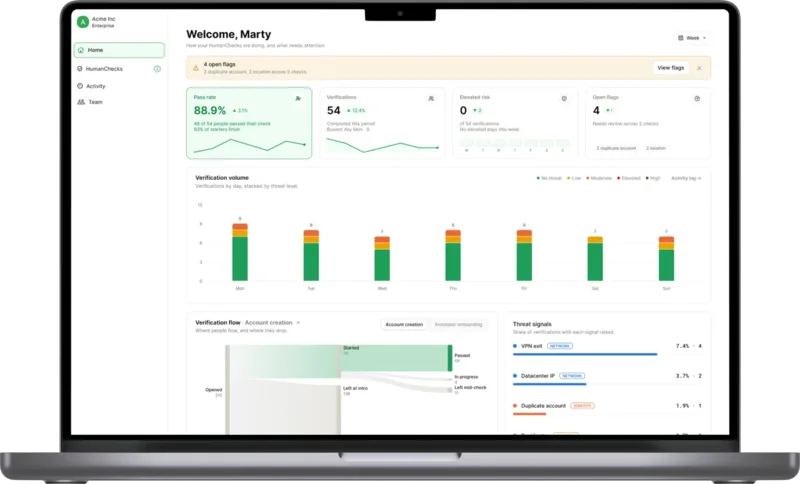
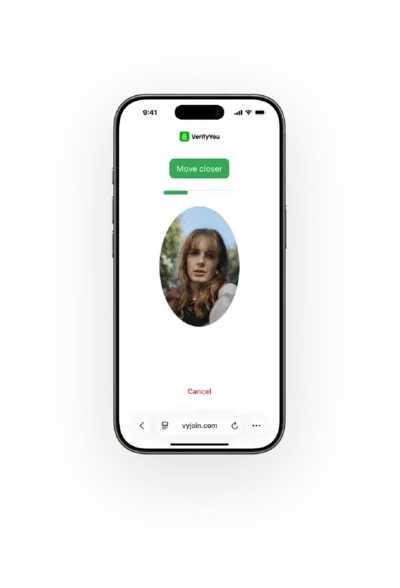
Passive signals run on every application, and a 3 second selfie, when the signals flag risk or you choose, confirms the person starting on day one is the one who applied.
The problem
How hiring fraud works now
- Different personInterviewDay one
The proxy interviewee
A stronger speaker takes the interview, and someone else does the job once the offer is signed.
- Video interviewJordan M.Live, 4:12In progressInterviewer seesLooks real
The deepfaked interview
A generated face and voice sit in for the real candidate on a live video call, polished enough to pass.
- Jordan M.J. MartinezJ.M. RiveraSame face
One person, five names
The same applicant shows up in your pipeline under a stack of different names, emails and resumes.
Where the check sits
From application to day one
01
Passive signals score every application
Network, device and behavior signals run in the background on every application and build each candidate's history, flagging duplicate devices, proxy networks and emails already in your pipeline.
02
Risky applicants take a face check
When the signals flag risk, a 3 second anonymous selfie sets the candidate's baseline face before the interview is booked. Strong candidates never see it.
03
Checked again on day one
Before the interview and before day one, a quick re-check confirms the same live, unique person is joining, not someone else logging in under their name.
Candidate 22914 applications today · 2 email matchesElevated
The platform
Passive defenses first, proof of human when it counts.
Why now
Remote hiring fraud reached the DOJ
From our own hiring: 73 fake applicant profiles were sent our check. Not one put a face on camera.
That was our own engineering job posting (a snapshot from September 2026). Every applicant we approved was a real, unique person, so no one could apply twice. The fraud left over came through the inbox: real applicants whose email a third party was running, and our signals flagged them before any interview.

A solution for every scenario
Let's talk trust
Start with a free pilot: see what the check catches on your own users, with no dev work to begin.
With tools like VerifyYou, AI becomes a force for good. It helps prevent AI-driven fraud and can be done with much lower friction than what we built over the years.
Built by humans from
- Quora
- Square
- Gusto
- Cohere Health
- Accenture
Security
Privacy and security in every decision
We keep a face code, not the photo, and hold it under SOC 2 Type II and ISO 27001:2022 compliant controls.
No images stored. VerifyYou does not store images.
No ID or documents. HumanCheck anonymously confirms there is a real, live, unique person, with no name or ID.
A face code, not a photo. We treat it as sensitive biometric data.
 SOC 2 Type II
 ISO 27001:2022
 ISO/IEC 30107-3 PAD Level 1 & 2
 GDPR compliant
Common questions
Will strong candidates drop out of the process?
You decide who sees the check and when: at application, before the interview, or only for candidates your signals flag. Passive signals run on everyone, and the selfie asks for no ID or documents.
What if a candidate's laptop has no camera?
They scan a QR code and finish on their phone. The check can run on a desktop too, but a phone gives a stronger signal.
Can it catch someone applying under five different names?
Yes. A new name, a new email and a fresh resume still bring the same face, and HumanCheck anonymously matches it to the one already on record in your candidate pool.
What about AI-polished answers showing up in interviews?
An anonymous HumanCheck confirms the same live, unique person is on the call. It doesn't grade what they say, so keep your own read on answers that sound too rehearsed, and pair it with the location signals that flag a call coming from somewhere unexpected.
What does the check actually tell us about the candidate?
That they're a real, live, unique person, and whether they've already applied under another name. By design, it stops there: you get the match, never a name or a document.
Do you store photos of our users?
No. We keep a face code, not your users' images.
How much work is it to add?
It's two API calls: one to start the check and one to read the result.
Do we have to replace our KYC or bot tools?
No. It sits on top of your stack, so you keep your KYC and bot tools.
What does it cost?
It's 50 to 100 times cheaper than KYC. You pay per check, and nobody uploads an ID document.
Resources
Keep learning

Blog
The Best Human Verification Platforms in 2026
Human verification covers four different product categories that solve four different problems. This guide separates them, compares what each one confirms, and shows which published prices vendors actually disclose.
Read the post
Blog
Sybil Attacks in AI Data Labeling: How Platforms Prevent Them in 2026
How one person running many annotator accounts distorts training data, how the major labeling platforms defend against it today, and how the tools built to stop it compare.
Read the post
Blog
The Most Expensive Part of an Odyssey Ticket Is the Missing Verification
The Odyssey sold out every IMAX 70mm screening in New York, and the resale chaos that followed shows what happens when scarcity meets anonymity.
Read the post
Ready to get started?
VerifyYou scales trust: passive signals on every session, a face check only when risk calls for it.