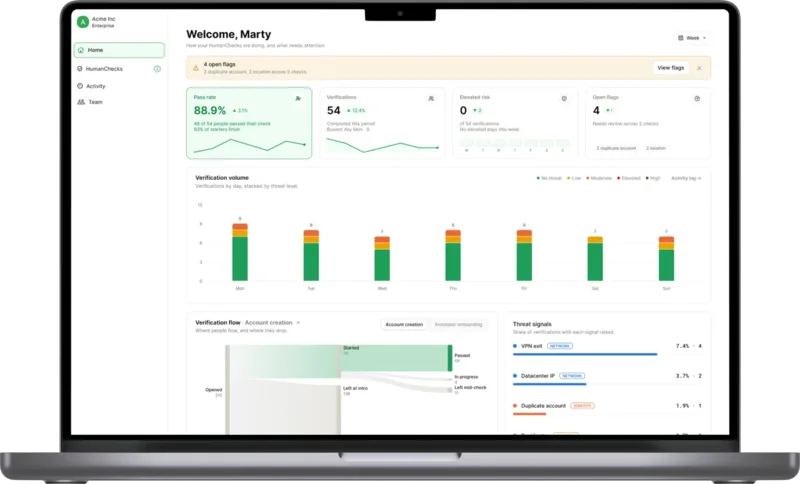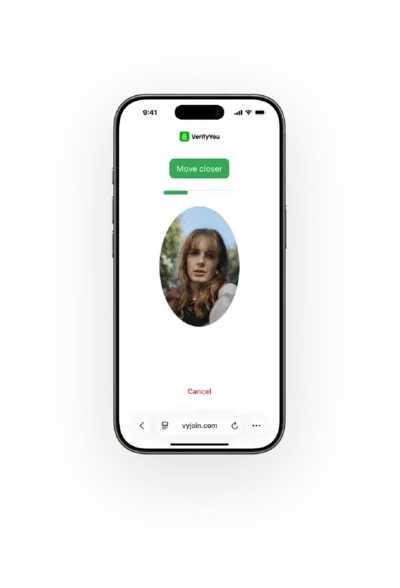
Put anonymous HumanCheck on your next round of onboarding, or send it to experts already in your network by email invite (beta), and see which profiles share a face.
Expert networks
Vetting checks the profile.The call confirms the same person holds it.
Passive signals run on every session, and a 3 second selfie, when they flag risk or before the calls you choose, confirms the same live, unique person holds the profile, no ID required.
The problem
How the fraud reaches a client call
- FlaggedSenior claims analyst12 years, insuranceProfile saysLondonConnects fromData center VPN
The fake expert
A profile is vetted as a senior insider with the right employer, and the person on the client call has never held the role and is often nowhere near the country it claims.
- profile_2291profile_5518profile_7030Same person
The duplicate profile
One person runs several profiles under different names and emails, gets screened into the same project more than once and collects a fee for each one.
- Different personVettedOn call
The stand-in on the call
Someone other than the vetted expert joins the actual call, and the client never learns the person talking was never screened.
What changes
Still the expert you vetted, call after call.
01
Passive signals score every session
Network and device signals run in the background on every login and call request, and build a history for the profile: past scores and how it typically connects.
02
Risky sessions take an anonymous face check
When the signals flag risk, or before a call you choose, a 3 second selfie confirms a live, unique person holds the profile. Good experts never see it.
03
Right before the call starts
Before the calls you choose, a quick re-check confirms the person about to join is the one who was vetted, and the same check can run again before the call fee pays out.
Profile 48216 calls this monthElevated
The platform
Passive defenses first, proof of human when it counts.
Proof
See it on your own expert pool


A solution for every scenario
Let's talk trust
Start with a free pilot: see what the check catches on your own users, with no dev work to begin.
With tools like VerifyYou, AI becomes a force for good. It helps prevent AI-driven fraud and can be done with much lower friction than what we built over the years.
Built by humans from
- Quora
- Square
- Gusto
- Cohere Health
- Accenture
Security
Privacy and security in every decision
We keep a face code, not the photo, and hold it under SOC 2 Type II and ISO 27001:2022 compliant controls.
No images stored. VerifyYou does not store images.
No ID or documents. HumanCheck anonymously confirms there is a real, live, unique person, with no name or ID.
A face code, not a photo. We treat it as sensitive biometric data.
 SOC 2 Type II
 ISO 27001:2022
 ISO/IEC 30107-3 PAD Level 1 & 2
 GDPR compliant
Common questions
Do we learn the expert's name?
No. The check never asks for a name. You get a live-and-unique match and whether this profile has verified with you before. Experts upload no documents, and the face code is what lets a returning expert be matched to their first check.
Does it check an expert's employer or CV?
No. HumanCheck anonymously proves one live, unique person per profile. It doesn't confirm where they work, what's on their CV or whether they're free to speak on a topic, so employment checks and MNPI compliance stay in your compliance process.
What if an expert doesn't want to take a selfie?
The check asks for no name, no ID and no documents. VerifyYou does not store images; we keep a face code, a template made from the face, instead. Each person sees what's shared before they start. People who back out at the selfie step are often the ones you'd want to stop.
Can it catch someone standing in for the vetted expert on the call?
Yes, when the check runs right before the call. A quick re-check confirms the face on the profile is the face about to join, so a stand-in shows up as a different person before the call starts.
What about a genuine expert calling in from a VPN or a corporate network?
Network tools flag a genuine expert who connects from a data center or a corporate VPN. A live check shows a real, unique person is there, and with Allow and flag set, they join the call while your team reviews the flag.
If we remove an expert, can they just sign up again?
Their face stays on record as a face code, a template made from the face, not a photo. Their next profile, under a new name and email, matches it before it's screened into a project.
Do you store photos of our users?
No. We keep a face code, not your users' images.
How much work is it to add?
It's two API calls: one to start the check and one to read the result.
Do we have to replace our KYC or bot tools?
No. It sits on top of your stack, so you keep your KYC and bot tools.
What does it cost?
It's 50 to 100 times cheaper than KYC. You pay per check, and nobody uploads an ID document.
Resources
Keep learning
Blog
Every Extra Step Costs You a Respondent
Verification protects your sample. It also thins it. Frictionless reverification is how research teams stop choosing between the two.
Read the post
Blog
The Label Is Only as Good as the Human Behind It
Expert-rate annotation pays whoever holds the account, regardless of who opened it.
Read the post
Blog
The Best Human Verification Platforms in 2026
Human verification covers four different product categories that solve four different problems. This guide separates them, compares what each one confirms, and shows which published prices vendors actually disclose.
Read the post
Ready to get started?
VerifyYou scales trust: passive signals on every session, a face check only when risk calls for it.