Proof of Human, on the Phone You Already Have
Why fraud teams keep trading security against cost and friction, how a passive-first check on an ordinary phone gets all three, and why a network of verified humans gets stronger with every check.
White paper · October 2026
Get a demoSummary
Every fraud team we talk to weighs three things: how much fraud a check stops, what it costs, and how many honest people it loses. One buyer called it a "game of friction versus security." Today's tools make you give one up. ID checks are strong, but they cost one to two dollars a check and send good users away. CAPTCHAs and bot scores are cheap and invisible, and AI now passes them.
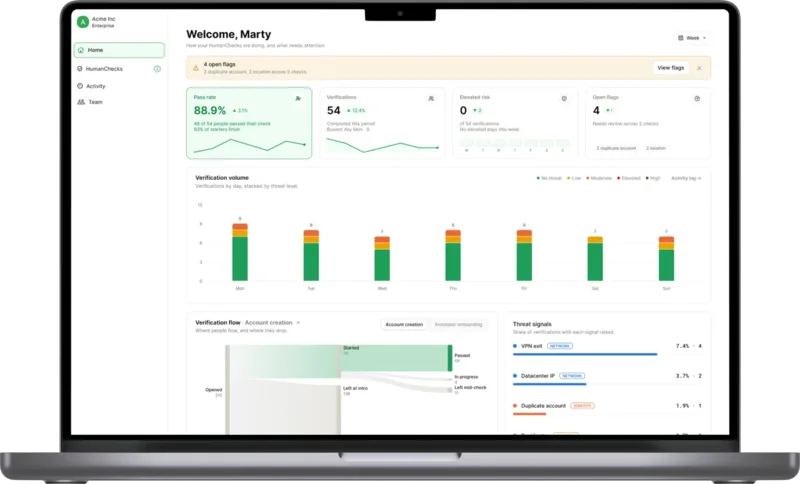
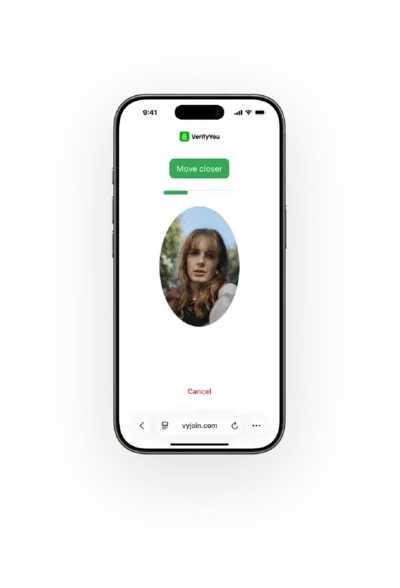
We think the choice is false, because most sessions never need the expensive check. VerifyYou runs passive signals on every session. Only when they flag risk, or when the platform decides a moment matters, does a person take an anonymous HumanCheck: a selfie on their own phone that takes about 3 seconds and asks for no ID. It costs 50 to 100 times less than a document check.
The second idea is the one we care about most. Fraud travels: the people who fake survey answers, labeling work and signups do it on every platform that pays. A platform checking alone sees only its own duplicates. A network of verified humans sees the pattern, and every person verified makes the next check lighter for honest people and harder for fraudsters. The same network lets a site know that one live, unique person stands behind each AI agent.
1. Software can pass for a person
The internet ran for decades on cheap proxies for humanness, like an email address or a solved puzzle. Each can now be faked for less than what it protects.
- Content checks no longer catch AI. In a 2025 study in PNAS, Sean Westwood of Dartmouth found that AI passed survey attention checks 99.8% of the time.
- Bots are most of the traffic. Cloudflare's data, reported by the Washington Post in August 2026, puts automated traffic at roughly 60% of web traffic.
- Accounts are a market. Business Insider found at least 100 Facebook groups selling access to AI-training accounts in December 2025. AlgorithmWatch documented a verified account resold for "70 dollars with a proxy."
A check on what someone typed or how they clicked tests behavior, and software behaves well. Two questions still have hard answers: is a living person in front of the camera right now, and is it the same person who was here before?
2. The trade-off buyers describe
Buyers describe this as a budget with three lines in it.
Security is how much fraud a check stops at the moment money moves, such as a payout or a signup bonus.
Cost is the price of one check times volume, and buyers talk about it in cents. One said "it's possible to do successful age verification for pennies." Another called full ID checks "prohibitively expensive" for most uses.
Friction is the honest people a check loses. A face check put in front of everyone at signup is "a conversion killer," in one buyer's words.
Each familiar tool buys one of these with the others:
- Document checks (KYC, short for know your customer) match a face to a government ID. They suit banks. For a survey panel or a labeling marketplace they cost too much (published self-serve prices from Veriff, Sumsub and Stripe run from about $0.80 to $1.89 per check), they ask for a name the platform has no use for, and they shut out people without an accepted document. One buyer watched a group of hand-recruited specialists fail an ID vendor's check, every one of them.
- CAPTCHAs and passive bot scores are cheap and mostly invisible. They produce a probability, and AI has become very good at moving it.
- Dedicated hardware, such as World's iris-scanning Orb, is accurate about uniqueness, but a person has to travel to one. World reports more than 18 million Orb-verified people, and regulators and courts in Spain, Kenya, Germany and Colombia have ordered it to pause collection or delete data. Its newer app selfie, Live Check, needs no Orb; World rates it medium assurance.
| Approach | Security | Cost | Friction |
|---|---|---|---|
| Document checks (KYC) | Matches a face to a government ID. | About $0.80 to $1.89 per check at published self-serve prices. | Asks for a name and a document. Shuts out people without an accepted ID. |
| CAPTCHAs and bot scores | A probability, which AI has become very good at moving. | Cheap. | Mostly invisible. |
| Dedicated hardware (World’s Orb) | Accurate about uniqueness. | No published per-check price. | A person has to travel to an Orb. |
| Passive first, then an anonymous HumanCheck | A live, unique face check wherever the signals flag risk or the platform sets the floor. | 50 to 100 times less than a document check, paid only on sessions that need one. | Most honest people never see it. The rest spend about 3 seconds on their own phone. |
A second split matters as much: what a check asks of a person, and whether its result lasts beyond one session on one platform.
Three companies come closest. Persona and Jumio now let a returning user reuse an earlier check (Jumio with a selfie, Persona through a passkey wallet), but that proof still rests on the ID, so people who can't or won't show one are still left out. Realeyes, like us, checks a live face in a few seconds with no ID. Its duplicate check, as it describes it, covers one customer's own accounts. Ours does that and also tells a platform when someone was flagged on another platform in the network.
3. How passive-first gets all three
The way out is to spend cost and friction only where the risk is, as Figure 1 shows.
That makes the signals a filter, and the platform sets the floor. It can require the face check at every payout or bonus whatever the signals say, so a fraudster who looks clean to the signals still meets the camera before any money moves.
Security
The face check answers two questions. The first is liveness: is a real person in front of the camera, or a photo, a screen or a mask? iBeta, an accredited lab, tested the liveness engine we run on against ISO/IEC 30107-3, the international standard for these attacks. At Levels 1 and 2 in late 2023, testers made 1,650 attempts with printed photos, screens, masks and 3D animation. None of the 1,650 was accepted. The lab tested the engine with its colored-light step and a lower pass threshold than ours. We run a movement-only step, which is faster, at a stricter threshold. The engine's provider reports that all 550 genuine attempts in those tests passed at the lab's setting.
| Test | Held up to the camera | Attempts | Accepted |
|---|---|---|---|
| iBeta Level 1, 11 Sep 2023 | Printed photos, photos and videos on screens, 3D masks | 900 | 0 |
| iBeta Level 2, 19 Oct 2023 | Silicone, latex, contoured and 3D-printed masks, 3D animation | 750 | 0 |
| Genuine attempts, both levels | Real people | 550 | All 550, per the engine’s provider |
Those were presentation attacks, things held up to a camera. A harder attack injects synthetic video into the camera feed. The anonymous HumanCheck is designed to block injected deepfakes too, but iBeta did not test injection and we don't claim it did.
The second question is uniqueness. From the selfie, HumanCheck anonymously computes a face code, a list of numbers used for matching. Each new check is compared with earlier codes. Someone who comes back with a new email and a new phone number still matches. The first account stays; the duplicates get flagged.
One platform's result: $150,000 in fraud loss, stopped within 3 weeks of starting, without requiring any dev effort on their end.
Cost
An anonymous HumanCheck costs 50 to 100 times less than a document check. And since signals alone can screen most of a platform's traffic, a platform pays for a face check only on the sessions that need one.
Friction
In a passive-first setup, most honest people never see the check. The ones who do spend about 3 seconds in front of their own camera and hand over no document. The anonymous HumanCheck is designed to keep drop-off low. Wes Michael, who built the patient panel Rare Patient Voice, put it this way: "With tools like VerifyYou, AI becomes a force for good. It helps prevent AI-driven fraud and can be done with much lower friction than what we built over the years."
4. Why it scales
Our buyers check from a few thousand people a month to, for one games company, "single-digit millions a month" in one country. "Global is one of the key requirements," that buyer said. Five design choices serve both ends.
- The hardware is already in people's pockets. No device to ship, nowhere to travel. Almost any phone with a front camera and a current browser can run the check.
- There are no documents. A face needs no list of supported IDs by country.
- The price allows more checks. A platform can afford a check at every payout instead of once at signup.
- False matches stay rare. A duplicate check compares a face only within the platform's own users, or a group it defines such as one study, a pool far smaller than the planet. A match goes to the platform's own review; nobody is banned automatically.
- Setup is short. Run real volume in 15 minutes with our no-code integration, or get live in a few hours with our code integration.
5. The network of humans
Anyone can buy liveness, and we do. What we own is the network: unique humans with check histories, which gets stronger with every check and every platform that joins.
Fraud scales by reuse: one person, many accounts, many platforms. A defense that forgets each check repeats its work while the fraudster's tools carry over. Buyers see this. One described people doing it "on repeat" across platform after platform, wherever "they can make a quick buck." Another, buying survey responses from many partners, worried about "the same respondent coming in from different partners." Each sees one slice of the pattern.
A network joins the slices, in two directions.
- Honest people carry their proof. Someone verified on one platform can use that proof on the next one, anonymously, so the platform starts from a known human instead of a stranger.
- Fraudsters carry their history. If a person has been flagged elsewhere in our network, the platform gets an anonymous signal. We never say which platform, and no name changes hands.
Two kinds of matching run side by side. The duplicate check in section 4 stays inside one platform's own group, so false matches stay rare and the platform can act on them. The network check is wider and softer: it tells a platform that a person was flagged somewhere else, as one more signal for its own review, never as an automatic block.
On day one, and later
On day one, a platform gets passive signals, a live face check and duplicate detection across its own users, which catches the most common fraud: one person, many accounts. The network improves after that. Each platform that joins adds the people it has checked, so a new signup is more likely to arrive already known, as honest or flagged. In return, a platform's own results feed the network as anonymous signals with no names or photos.
One human per agent
People now send AI agents to sign up, buy and apply for them. New protocols, such as the Personal Agent Protocol, PACT and AP2, tell a site which agent is acting and with what permissions. None of them checks that a live, unique person stands behind the agent, so one person can run a thousand.
Know Your Agent fills that gap. The site decides which agents it allows and, action by action, what proof it needs: a unique human, an age, a location. Because each agent traces back to one person, the site can allow one agent per human and ban the person rather than just the agent, without the cost of KYC or collecting names and documents. The person gets one place to approve what their agents may do, with a single tap, and the agent and the site get only the proof they asked for, never a name or a document. We call it the Trust OS: one human per agent.
6. The hard questions
"Can't someone just get a roommate to do the selfie?"
Once, yes. The roommate's face then becomes that account's face code, so it can't verify a second account, and a re-check before payout has to match it again. The same re-check stops account resale: a buyer's face won't match the seller's, so a bought account can't cash out.
"What about deepfakes injected into the camera feed?"
The anonymous HumanCheck is designed to block them, though no independent lab has tested that yet. Injection is still a minority of attacks: 10.3% of fraudulent selfies in Persona's 2026 H1 report, against 86.2% presentation attacks. Its share is growing.
"Will people trust a face check?"
We don't store images. The face code persists, because uniqueness depends on comparing new checks with old ones, and we hold it under SOC 2 Type II and ISO 27001:2022 compliant controls. The platform learns that a live, unique person passed. It does not learn a name.
7. What we have not proven yet
- Independent testing against injection attacks.
- Performance at the scale of the largest consumer platforms.
- Field results as rigorous as the lab's. iBeta tested with cooperative subjects on one Android phone, and with the engine's colored-light step, which our setup does not use.
- Drop-off. We don't yet publish a completion rate we would stand behind for every audience.
- How often a new check already matches someone in the network.
- A published, named customer case study.
We would rather you read these here than find them later.
Sources
- Westwood, S. J., PNAS, 2025: AI passing survey attention checks.
- Washington Post, citing Cloudflare data, August 2026.
- Business Insider, December 2025.
- AlgorithmWatch, May 2025: resale of verified data-labeling accounts.
- Veriff, Sumsub and Stripe published self-serve pricing.
- World Foundation, funding announcement, 24 July 2026: more than 18 million humans verified by an Orb. Orders concerning World in Spain (AEPD, March 2024), Kenya (High Court, May 2025), Germany (BayLDA) and Colombia (SIC).
- ISO/IEC 30107-3, biometric presentation attack detection testing.
- iBeta Quality Assurance, ISO/IEC 30107-3 confirmation letters: Level 1, 11 September 2023 (6 attack types, 900 attacks, 0% accepted); Level 2, 19 October 2023 (5 attack types, 750 attacks, 0% accepted).
- The liveness engine provider's AI service card (November 2023): 550 genuine attempts across both levels, all accepted at a confidence threshold of 50; its July 2025 release notes describe the movement-only setting.
- Persona, 2026 H1 fraud report.
- World ID Live Check, world.org.
- Persona, Jumio and Realeyes, from each company's own materials, October 2026: Persona (Persona Wallet, Correlated Verifications), Jumio (selfie.DONE, September 2026), Realeyes (VerifEye platform and docs).
- Agent protocols: Sierra (Personal Agent Protocol draft, October 2026), Decagon (PACT, October 2026), Google Cloud (AP2, September 2025).
- Wes Michael, Rare Patient Voice, in conversation with VerifyYou (HumanHour, 2026).
- Buyer quotes: VerifyYou sales calls in 2026, used without names.