On October 6, Sierra and Meta announced the Personal Agent Protocol and Decagon open-sourced PACT. Both describe which agent is acting and what it may do. Neither checks for a live, unique human behind it.
Sierra and Meta, Personal Agent Protocol; Decagon, PACT, 6 October 2026Know Your Agent
Agent protocols name the agent.We prove the human behind it.
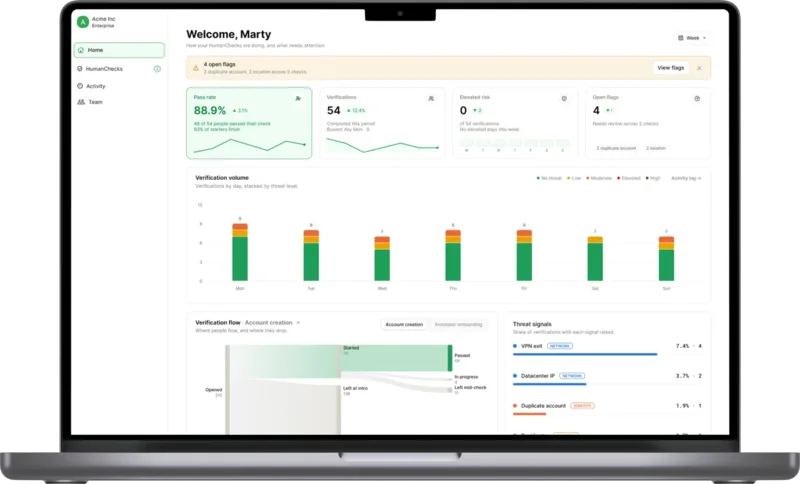
Recognize the agent, and when an action needs it, its person confirms a live, unique human with an anonymous 3 second selfie and no ID. Your rules then apply to the person.
The problem
A protocol's traffic names a tool, not the person behind it.
Before you let an agent act, you need four answers: which agent it is, whether a real, unique person is behind it, whether that person can show what the action needs, and what they allowed.
- Booking agentShopping agentSupport agentSame person
One person, many agents
Each agent signs up under its own email, so one person runs a hundred agents and buys a hundred tickets while your limits count a hundred customers.
- AgentNo faceIncoming requestNo agent protocolCOCheckout stepAUAutomated patternFlagged
Agents that won't say what they are
A declared agent names itself. An undeclared one looks like ordinary traffic, with nothing to show a person is behind it.
- New agentSame faceBehind new agentBanned person
The banned person's new agent
You block someone and they come back behind a different agent, a new email or a new key, looking like a first-time visitor.
How it works
One agent per person, with the person proven
01
An agent arrives, and you know which one
A declared agent is recognized by name. Passive signals flag one that doesn't say what it is, and it's asked to show a person behind it.
02
Its person proves what the action needs
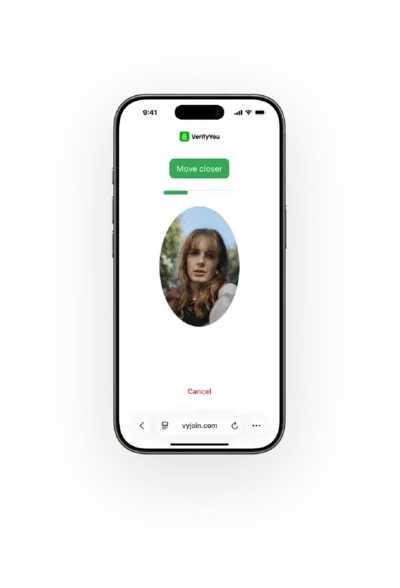
We send a link back through the agent. Its person taps it and takes an anonymous HumanCheck, about 3 seconds and no ID: a live, unique human, or an estimated age range where you ask for one.
03
Your rules follow the person
You choose which actions need proof and what each agent may do. Limits count people, so one person gets one agent's worth, and a ban lands on the person, not just the agent.
Which agent
SAShopping agentDeclared
UVUnknown visitorUndeclared
Checkout
AgentShopping agent
ActionBuy 1 ticket
NeedsA human
The platform
Passive defenses first, proof of human when it counts.
Why now
The agent protocols arrived. The human didn't.
Put one action behind the check, like checkout. A free pilot shows you how many agents reach it, how many say what they are, and how many trace back to the same person.





A solution for every scenario
Let's talk trust
Start with a free pilot: see what the check catches on your own users, with no dev work to begin.
With tools like VerifyYou, AI becomes a force for good. It helps prevent AI-driven fraud and can be done with much lower friction than what we built over the years.
Built by humans from
- Quora
- Square
- Gusto
- Cohere Health
- Accenture
Security
Privacy and security in every decision
We keep a face code, not the photo, and hold it under SOC 2 Type II and ISO 27001:2022 compliant controls.
No images stored. VerifyYou does not store images.
No ID or documents. HumanCheck anonymously confirms there is a real, live, unique person, with no name or ID.
A face code, not a photo. We treat it as sensitive biometric data.
 SOC 2 Type II
 ISO 27001:2022
 ISO/IEC 30107-3 PAD Level 1 & 2
 GDPR compliant
Common questions
Is Know Your Agent the same as bot blocking?
No. Know Your Agent is for an AI agent acting for a real person, booking, buying or signing up on their behalf. It proves the live, unique human behind that agent. Scalper bots and fake sign-ups belong to Scalping protection and Signup protection.
What can we require before an agent acts?
You set it per action, from a trust menu: nothing for browsing, a live, unique human for checkout, an estimated age range for age-restricted items. Most actions need nothing, so agents carry on unless a step you chose asks for proof.
How does the person behind the agent prove it?
We send a link back through the agent product. The agent passes it to its person, who taps it and takes an anonymous HumanCheck selfie, about 3 seconds and no ID. The agent carries on with the answer.
Does it work with the agent protocols already out there?
Those protocols describe which agent is acting and what it has been allowed to do. Know Your Agent adds the human: it plugs in alongside them as the human layer, or runs on its own.
Do you learn who the person behind the agent is?
No. You learn there's a live, unique human behind the agent, whether they've verified with you before, and whether they've shown what this action needs. Their name, face and personal details never reach you.
What happens when a person you banned comes back with a new agent?
The ban follows the person. Their new agent, email or key still meets the same face: Block, the default, turns them away; Allow and flag lets them in and raises a flag for your team.
Do you store photos of our users?
No. We keep a face code, not your users' images.
How much work is it to add?
It's two API calls: one to start the check and one to read the result.
Do we have to replace our KYC or bot tools?
No. It sits on top of your stack, so you keep your KYC and bot tools.
What does it cost?
It's 50 to 100 times cheaper than KYC. You pay per check, and nobody uploads an ID document.
Resources
Keep learning
Blog
1 Million AI Bots Just Got Their Own Social Network
1 Million AI Agents Just Got Their Own Social Network. Humans Are "Welcome to Observe."
Read the post
Blog
The Best Human Verification Platforms in 2026
Human verification covers four different product categories that solve four different problems. This guide separates them, compares what each one confirms, and shows which published prices vendors actually disclose.
Read the post
Blog
Sybil Attacks in AI Data Labeling: How Platforms Prevent Them in 2026
How one person running many annotator accounts distorts training data, how the major labeling platforms defend against it today, and how the tools built to stop it compare.
Read the post
Ready to get started?
VerifyYou scales trust: passive signals on every session, a face check only when risk calls for it.