Banned users stay banned.
Banned users stay out
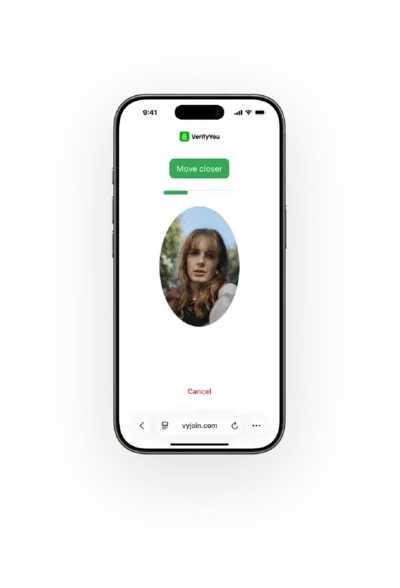
A sign-up only needs an email and a password. The ones that look automated or repeat also get a 3 second, anonymous face check, no ID.
An email and a password don't stop any of these three.
One person opens account after account with a fresh free email each time and claims the welcome offer every time.
A script opens hundreds of accounts in minutes, each with its own email, and every device looks new.
Someone you blocked returns under a new email and a new device, and your signals see a first-time visitor.
01
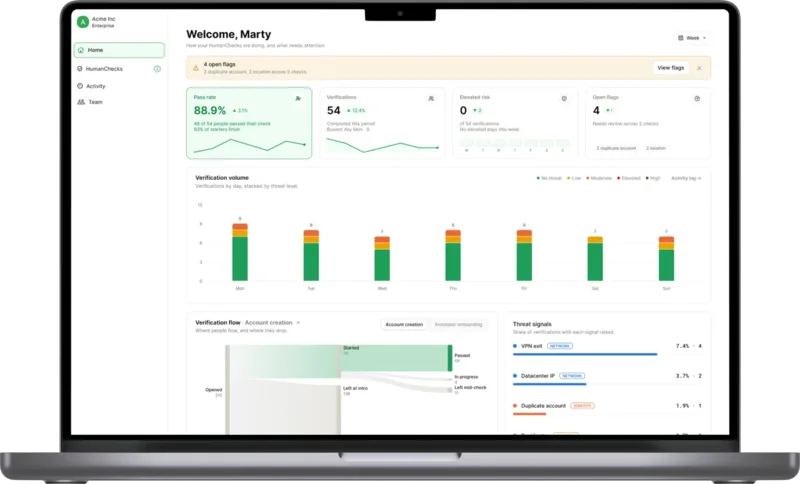
Device, network and behavior signals run in the background on every new account and flag what looks automated: an emulator, a residential proxy, typing that's too steady to be a person.
02
When the signals flag risk, a 3 second selfie confirms a live, unique human before the account opens. Most sign-ups never see it.
03
A face that matches one already on file is refused or flagged, your choice, whatever email, phone or device it used.
Start with a free pilot: see what the check catches on your own users, with no dev work to begin.
With tools like VerifyYou, AI becomes a force for good. It helps prevent AI-driven fraud and can be done with much lower friction than what we built over the years.
Built by humans from
We keep a face code, not the photo, and hold it under SOC 2 Type II and ISO 27001:2022 compliant controls.
No images stored. VerifyYou does not store images.
No ID or documents. HumanCheck anonymously confirms there is a real, live, unique person, with no name or ID.
A face code, not a photo. We treat it as sensitive biometric data.
 SOC 2 Type II
 ISO 27001:2022
 ISO/IEC 30107-3 PAD Level 1 & 2
 GDPR compliant
No. Recognition is on the face, not the device. A new phone, a new browser or a VPN still matches the face code already on file, so a new free email doesn't open a second account.
You decide. Block refuses the new sign-up and tells them an account already exists. Allow and flag lets it open and puts it in front of your team instead.
Yes. Turn on sign-in as owner, and the person who signed up first can prove it with a code sent to the email already on file.
Most sign-ups never see a check. Passive signals run on everyone in the background, and only the ones that look automated or repeat get the 3 second selfie.
Yes. A script that opens accounts in bulk fails the passive signals (no typing pattern, an emulator, a data center IP) before it reaches the face check, and any one that does still needs a different live face each time.
No. We keep a face code, not your users' images.
It's two API calls: one to start the check and one to read the result.
No. It sits on top of your stack, so you keep your KYC and bot tools.
It's 50 to 100 times cheaper than KYC. You pay per check, and nobody uploads an ID document.
Blog
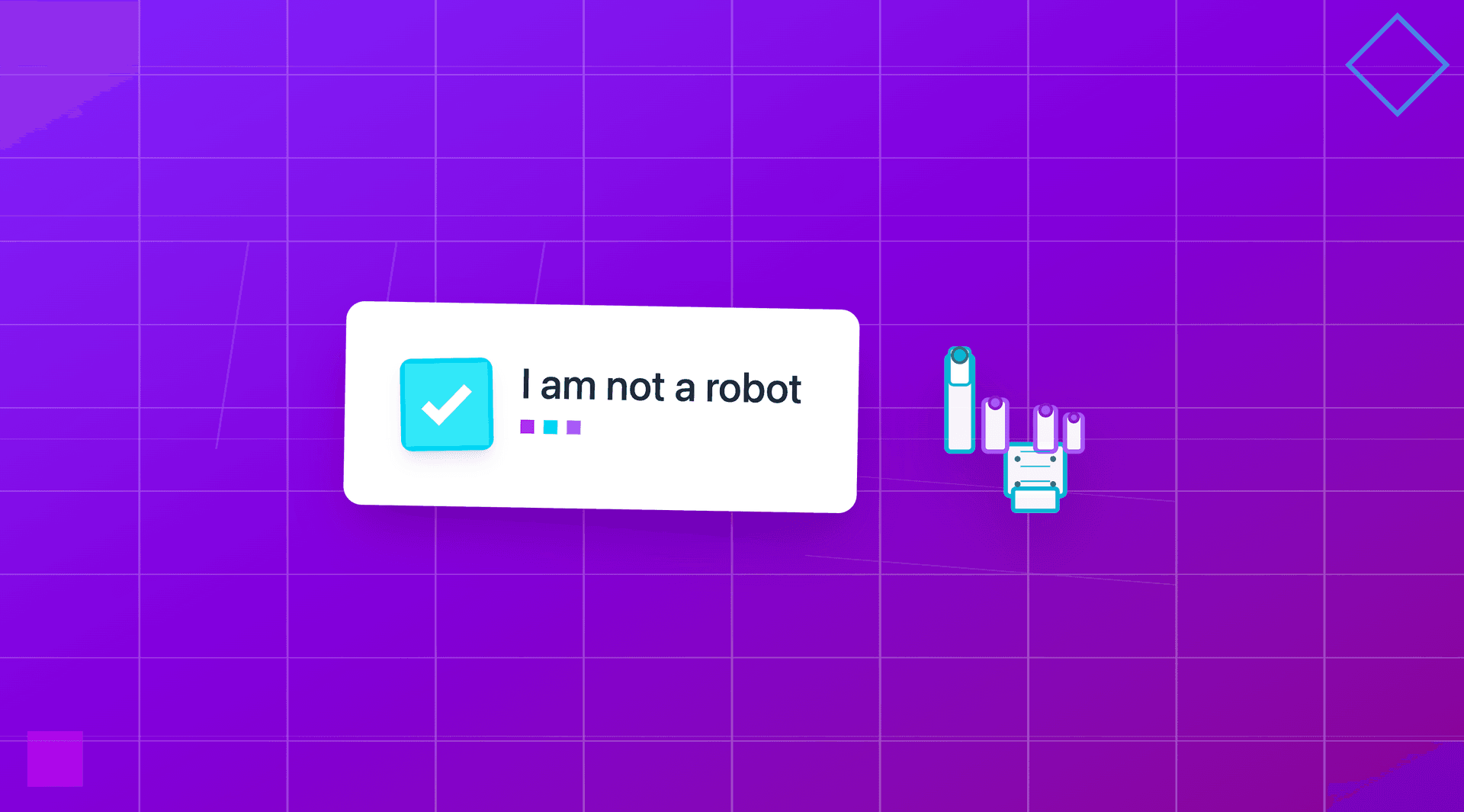
Why CAPTCHA Is Broken (And What Comes After It)
The test designed to stop bots has become the one thing bots reliably pass. Here's how we got here, and what actually comes next.
Read the post
Blog
The Bots Inside the Front Door: E-Commerce
Carding attacks, phantom customer signups, and the moment the Shopify fraud calendar quietly broke
Read the post
Case study
AI data labeling
$150,000 in fraud loss, stopped within 3 weeks of starting.
Read how it was caughtVerifyYou scales trust: passive signals on every session, a face check only when risk calls for it.
We use cookies. Privacy