An AI data labeling team that pays its contributors
$150,000 in fraud loss, stopped within 3 weeks of starting, without requiring any dev effort on their end.
A payout. A withdrawal. A limited drop. Each one can trigger a 3 second, anonymous selfie if background signals on the account flag risk, or you choose to ask.
The original owner passes the face check once, then a buyer logs in from a different city, behind a proxy, to collect the payout.
Someone gets into a real person's account and redeems the payout or the bonus before the owner notices.
A password reset or another sensitive action goes through on a text message code, which reaches whoever is holding the phone, not whoever opened the account.
01
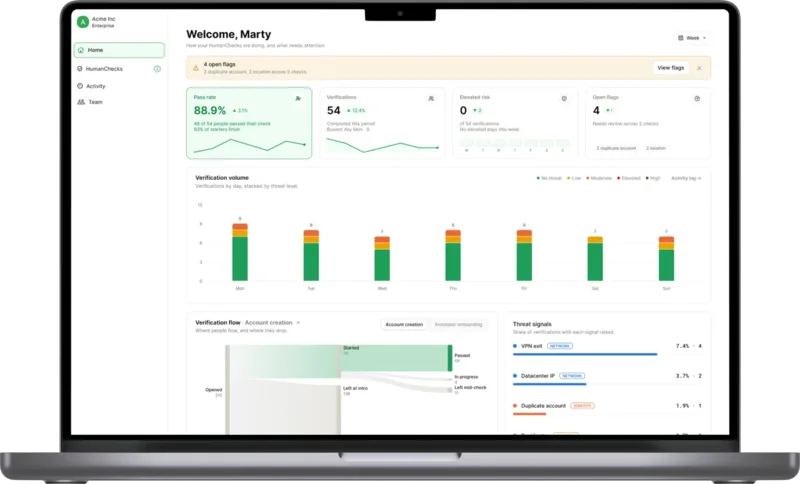
Device, network and behavior signals build a history for every account: today's risk, how many payouts it has requested this week, and anything already flagged.
02
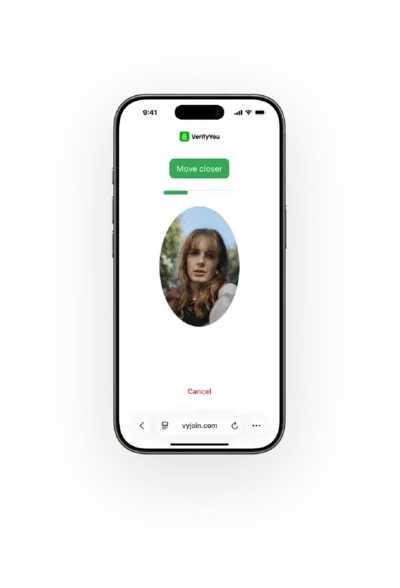
When the signals flag risk, or you choose to check every payout, a 3 second selfie confirms the person collecting the money is a live, unique human. Good accounts never see it.
03
Your server starts the check against the payout and confirms the result in the same request that releases the money, so a mismatch holds the funds instead of sending them.
An AI data labeling team that pays its contributors
$150,000 in fraud loss, stopped within 3 weeks of starting, without requiring any dev effort on their end.
Start with a free pilot: see what the check catches on your own users, with no dev work to begin.
With tools like VerifyYou, AI becomes a force for good. It helps prevent AI-driven fraud and can be done with much lower friction than what we built over the years.
Built by humans from
We keep a face code, not the photo, and hold it under SOC 2 Type II and ISO 27001:2022 compliant controls.
No images stored. VerifyYou does not store images.
No ID or documents. HumanCheck anonymously confirms there is a real, live, unique person, with no name or ID.
A face code, not a photo. We treat it as sensitive biometric data.
 SOC 2 Type II
 ISO 27001:2022
 ISO/IEC 30107-3 PAD Level 1 & 2
 GDPR compliant
No. You decide: run the anonymous HumanCheck only when your signals flag risk, or at every payout if you would rather. A returning person inside your skip window passes without scanning, and someone with a bound phone or email is recognized on a new device too.
Your server gets that result in the same call that would release the money, so you can hold the payout instead of sending it. What happens next is up to your workflow.
Yes. Your server decides when to start a check, so you can start one only above an amount you set. The verification limit then sets how often: once per lifetime for a one-off bonus, or once per period for a weekly payout.
No. A check at the payout tells you the person being paid is the live person who owns the account. It doesn't judge the work behind the payout, so a verified person can still hand a task to someone else and cash out themselves.
With a phone or email bound to the account at signup, the payout check compares the face asking for the money against the person who opened it, even from a new device.
No. We keep a face code, not your users' images.
It's two API calls: one to start the check and one to read the result.
No. It sits on top of your stack, so you keep your KYC and bot tools.
It's 50 to 100 times cheaper than KYC. You pay per check, and nobody uploads an ID document.
Blog
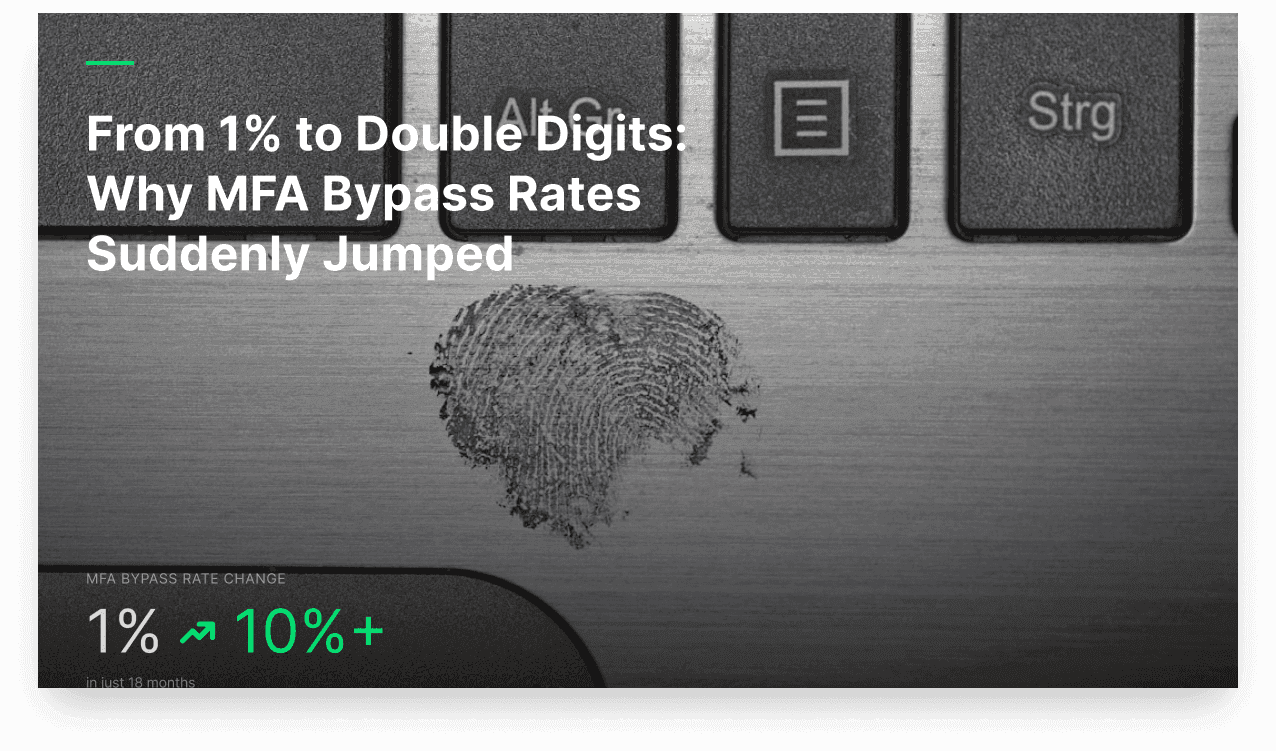
From 1% to Double Digits: Why MFA Bypass Rates Suddenly Jumped
Just 18 months ago, MFA (Multi-Factor Authentication) bypass rates were below 1%. Today, those rates have climbed into double digits.
Read the post
Blog
The Bots Inside the Front Door: E-Commerce
Carding attacks, phantom customer signups, and the moment the Shopify fraud calendar quietly broke
Read the postFAQ
Does it work with the fraud tools we already use?
Yes. Most teams keep their KYC and bot tools and add HumanCheck on top, anonymously, at the moments a passive signal can't settle, such as sign up or a payout.
See the answerVerifyYou scales trust: passive signals on every session, a face check only when risk calls for it.
We use cookies. Privacy