One account per person, whatever the email.
Duplicate fan check
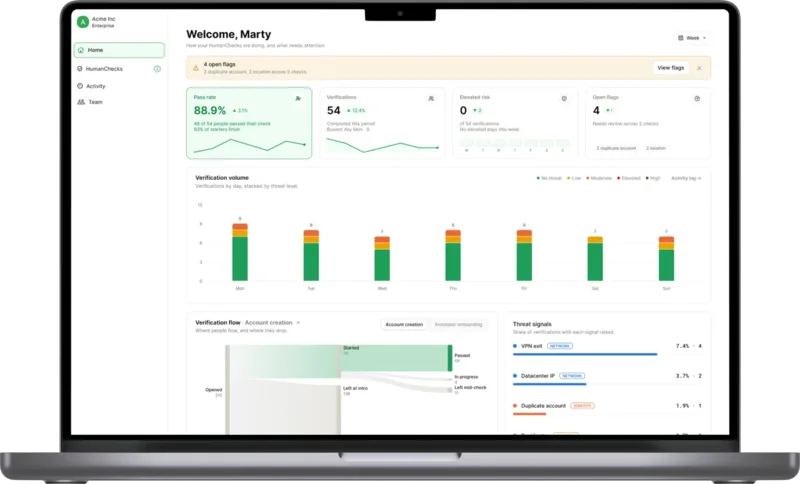
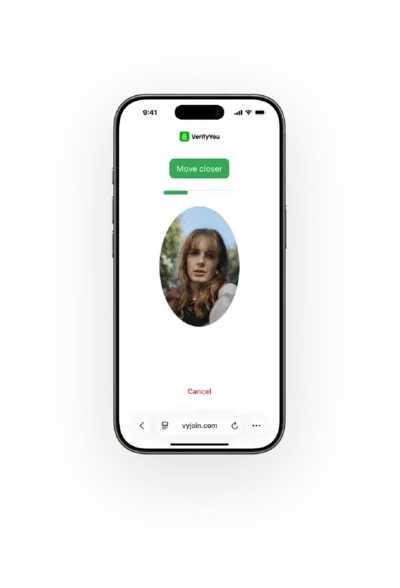
Where signals flag risk, or you choose to ask, an anonymous HumanCheck, about 3 seconds, confirms a unique person, no ID. Everything else is scored automatically, in the background, on every registration or checkout.
A limit only counts accounts, emails and cards. None of them tells you how many people are actually behind the order.
A script opens one account after another, each with a fresh email and card, and one person clears the limit again with every account.
A checkout script clears the form in milliseconds with no person behind it, while a real fan's page is still loading.
Forty orders in a drop can come from one person behind forty accounts, and the allocation meant for forty fans never reaches them.
01
Device, network and behavior signals run on every registration or checkout, and flag what looks automated or repeated: a VPN, a data center IP, Tor traffic, a browser that's been here under another name.
02
When the signals flag risk, an anonymous HumanCheck, about 3 seconds and no ID, confirms a live, unique person before a code or a place in the queue goes out.
03
Put the check at registration, ahead of the sale, so the queue itself carries nothing extra, and a returning fan on a known device skips the scan at checkout.
Start with a free pilot: see what the check catches on your own users, with no dev work to begin.
With tools like VerifyYou, AI becomes a force for good. It helps prevent AI-driven fraud and can be done with much lower friction than what we built over the years.
Built by humans from
We keep a face code, not the photo, and hold it under SOC 2 Type II and ISO 27001:2022 compliant controls.
No images stored. VerifyYou does not store images.
No ID or documents. HumanCheck anonymously confirms there is a real, live, unique person, with no name or ID.
A face code, not a photo. We treat it as sensitive biometric data.
 SOC 2 Type II
 ISO 27001:2022
 ISO/IEC 30107-3 PAD Level 1 & 2
 GDPR compliant
Put it at registration, before the sale opens, so the queue itself carries nothing extra. The check takes about 3 seconds, and a returning fan on a known device skips the scan.
No. Liveness confirms a live, unique person at the camera, not a photo, a mask or a replay held up to it. It's iBeta tested against exactly those presentation attacks.
Your choice. Scope uniqueness to a single presale or drop and each fan gets one registration in it, then is free to register again at the next one. The same setting works for sneakers, vinyl, merch or any limited run.
Block, the default, refuses the second registration outright. Allow and flag lets it through and raises it for your team to review before codes go out.
No. It makes the limit hold per person, so one person can't claim ten allocations behind ten accounts. A real fan who buys their own allowance and resells it is a job for your resale and transfer rules, not for us.
It's two API calls: one to start the check and one to read the result.
No. It sits on top of your stack, so you keep your KYC and bot tools.
It's 50 to 100 times cheaper than KYC. You pay per check, and nobody uploads an ID document.
Blog
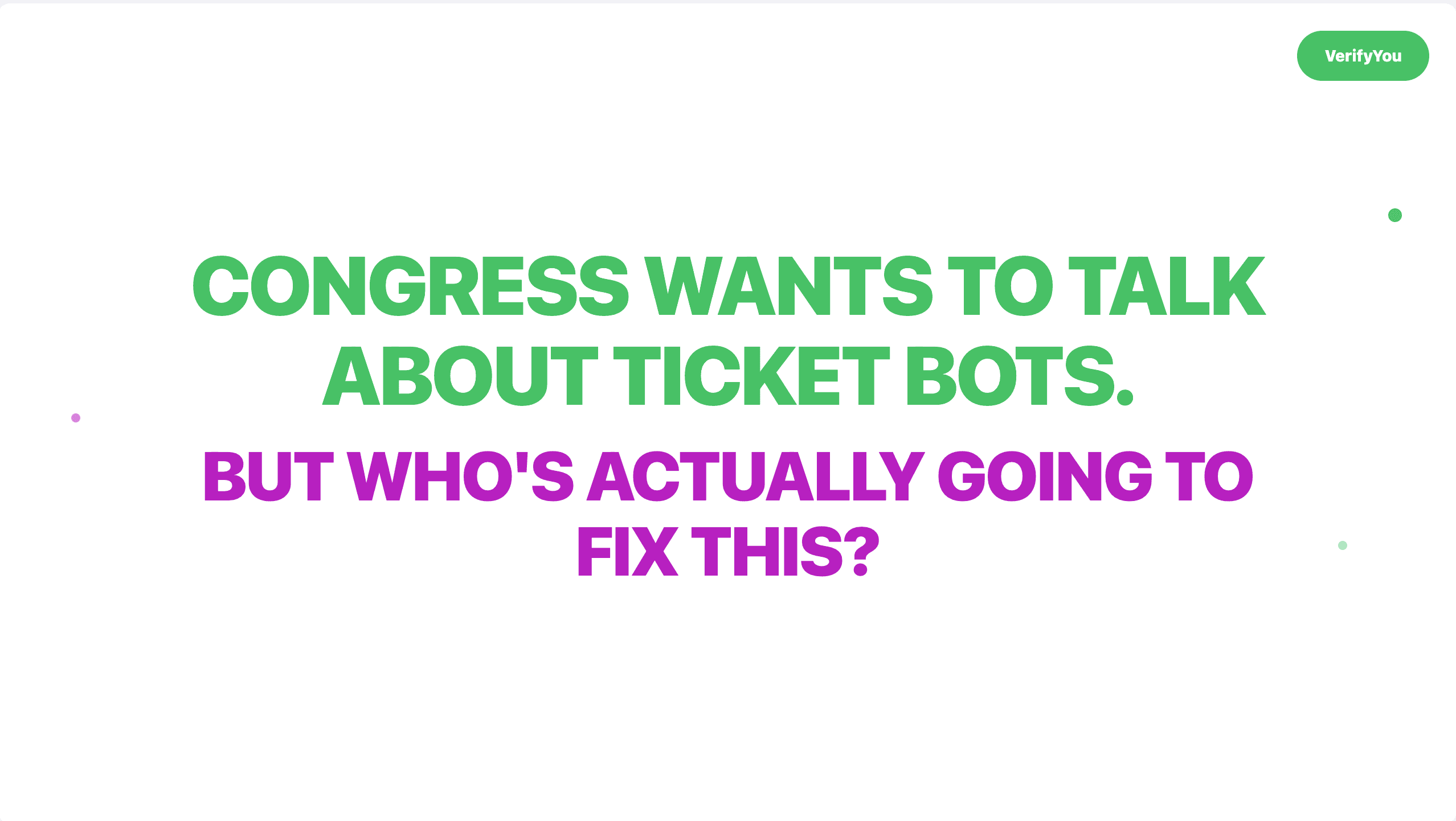
Congress Wants to Talk About Ticket Bots. But Who's Actually Going to Fix This?
Yesterday the U.S. Senate held a hearing called "Fees Rolled on All Summer Long." Yes, that's a Kid Rock reference.
Read the post
Blog
The Real Reason You Can't Get Tickets to Anything
The ticketing industry has spent years building walls that scalpers treat like speed bumps. Here's what's actually going on, and why the problem keeps getting worse.
Read the post
Blog
The Best Human Verification Platforms in 2026
Human verification covers four different product categories that solve four different problems. This guide separates them, compares what each one confirms, and shows which published prices vendors actually disclose.
Read the postVerifyYou scales trust: passive signals on every session, a face check only when risk calls for it.
We use cookies. Privacy