
One account per person, whatever the email.
Sign-up age gate
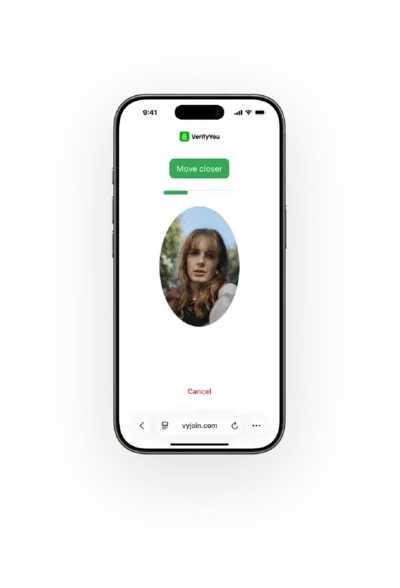
A 3 second, anonymous selfie is the only new step. It runs at the age-gated point you choose, confirms a live person, and returns an estimated age range, no ID. Everything before that is passive signals already running in the background of the session.
Anyone can enter a different year, and nothing at sign-up checks it against the face behind it.
A parent's login plays just as well for the child on it, so the age on file isn't the age at the screen.
Someone turned away at the gate comes back with a new email and a new birthday, and the birthday field lets them in.
01
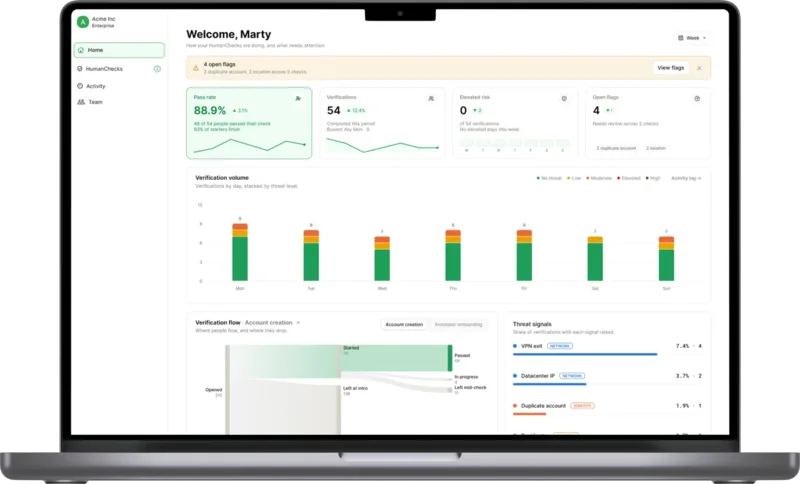
They score every session in the background and build a history, long before anyone reaches your age-gated step.
02
At the gate you choose, a 3 second anonymous HumanCheck confirms a live person and returns their estimated age range in the same scan.
03
Set the minimum: 13, 16, 18, 21 or your own. Anyone estimated below it is denied with the reason, so you can send them to an ID check or away.
Start with a free pilot: see what the check catches on your own users, with no dev work to begin.
With tools like VerifyYou, AI becomes a force for good. It helps prevent AI-driven fraud and can be done with much lower friction than what we built over the years.
Built by humans from
We keep a face code, not the photo, and hold it under SOC 2 Type II and ISO 27001:2022 compliant controls.
No images stored. VerifyYou does not store images.
No ID or documents. HumanCheck anonymously confirms there is a real, live, unique person, with no name or ID.
A face code, not a photo. We treat it as sensitive biometric data.
 SOC 2 Type II
 ISO 27001:2022
 ISO/IEC 30107-3 PAD Level 1 & 2
 GDPR compliant
No. It is an estimated age range from a selfie, not a document or a government ID. Ranges span several years and are least accurate right at a threshold like 18, so wherever the law requires proof, pair the estimate with an ID check.
The check denies them and your server gets the reason, so you can route them to an ID check, to a parental consent step you run, or away. Which fits is your call.
Not if the check runs where the child is. Put it at the age-gated step, or re-check at intervals, and a child on a parent's login gets their own estimate, not the age on file.
They can try, with a new email and a new birthday, but the anonymous scan recognizes their own face, and the account is blocked or flagged again, your choice.
No. Our privacy policy bars anyone under 13 from using VerifyYou's own services, so this is built for platforms whose users are 13 and over.
No. We keep a face code, not your users' images.
It's two API calls: one to start the check and one to read the result.
No. It sits on top of your stack, so you keep your KYC and bot tools.
It's 50 to 100 times cheaper than KYC. You pay per check, and nobody uploads an ID document.

Blog
Discord Wants Your Age. Or Your Papers. Pick One.
The platform's new age verification rollout reveals everything wrong with how the internet thinks about proving you're real.
Read the post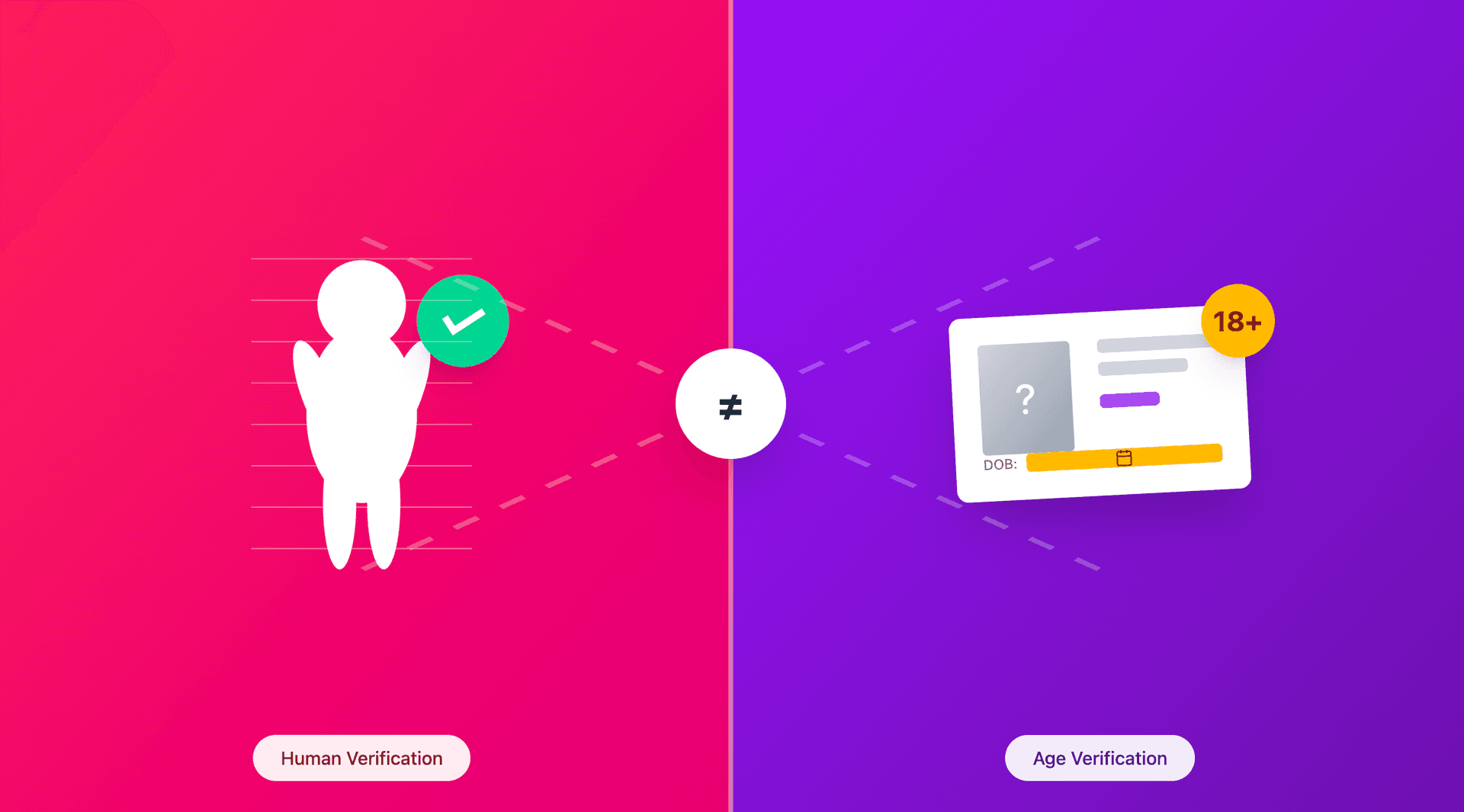
Blog
Human Verification vs. Age Verification: They're Solving Different Problems
Two different questions, two different tools. Conflating them is how you end up with bad policy, annoyed users, and a pile of government IDs stored somewhere you'd rather not think about.
Read the post
Blog
The Best Human Verification Platforms in 2026
Human verification covers four different product categories that solve four different problems. This guide separates them, compares what each one confirms, and shows which published prices vendors actually disclose.
Read the postVerifyYou scales trust: passive signals on every session, a face check only when risk calls for it.
We use cookies. Privacy