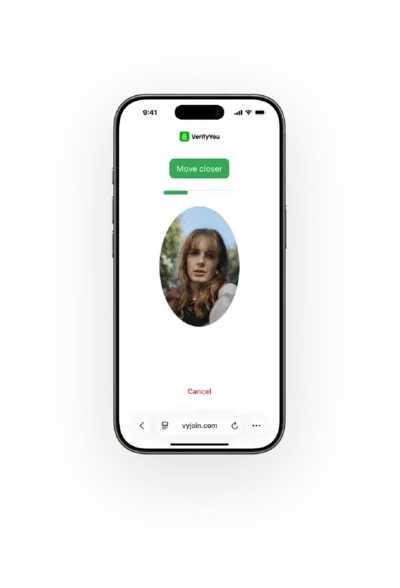
An estimated age range from the same selfie.
Set a minimum estimated age
You get the connection's location on everyone, read passively in the background. Add a 3 second selfie when you choose, and an estimated age range and gender come back to check against what people told you.
A screener records what someone types. None of these three show up there.
A respondent says 25 to qualify for a study, and nothing checks it until the data comes back skewed.
An annotator claims a country for the job, and a VPN or a residential proxy is the only thing between them and the client's rules.
A study needs women over 50, people type whatever opens the screener, and the quota fills with people who don't fit it.
01
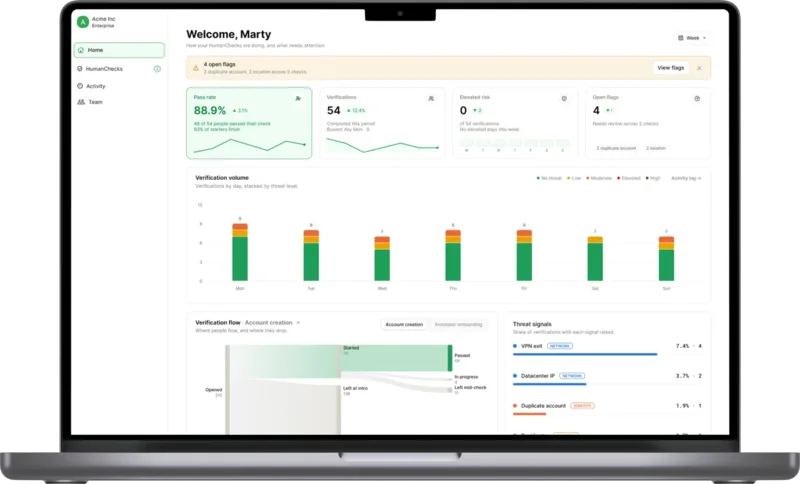
Network signals place the connection by country, region and city, and flag VPN, data center and Tor traffic, without asking the person anything.
02
When you choose, the same 3 second selfie that confirms a live, unique person also returns an estimated age range and gender.
03
The estimates land on the person's profile and in Activity. Filter by age, gender or country, export the slice, and hold it against the screener answers in your own records.
Start with a free pilot: see what the check catches on your own users, with no dev work to begin.
With tools like VerifyYou, AI becomes a force for good. It helps prevent AI-driven fraud and can be done with much lower friction than what we built over the years.
Built by humans from
We keep a face code, not the photo, and hold it under SOC 2 Type II and ISO 27001:2022 compliant controls.
No images stored. VerifyYou does not store images.
No ID or documents. HumanCheck anonymously confirms there is a real, live, unique person, with no name or ID.
A face code, not a photo. We treat it as sensitive biometric data.
 SOC 2 Type II
 ISO 27001:2022
 ISO/IEC 30107-3 PAD Level 1 & 2
 GDPR compliant
No. The check estimates what a face and a connection show. Professional and employment claims stay with your own vetting.
They can, so read one flag as a reason to look. A cluster of accounts all arriving from data center IPs says far more than one traveler on hotel wifi.
Yes, and it's shown as a range for that reason: a low and a high with an estimate between, not a single confident number. Treat one estimate as a signal, and a cluster of mismatches as a stronger one.
No. It comes from the connection's IP, so nothing is asked of the person and no location permission is requested. A VPN or a data center address is flagged as what it is, not treated as a real place.
Yes. Set a minimum estimated age of 13, 16, 18, 21 or one you choose, and anyone estimated below it is denied.
No. We keep a face code, not your users' images.
It's two API calls: one to start the check and one to read the result.
No. It sits on top of your stack, so you keep your KYC and bot tools.
It's 50 to 100 times cheaper than KYC. You pay per check, and nobody uploads an ID document.
Blog
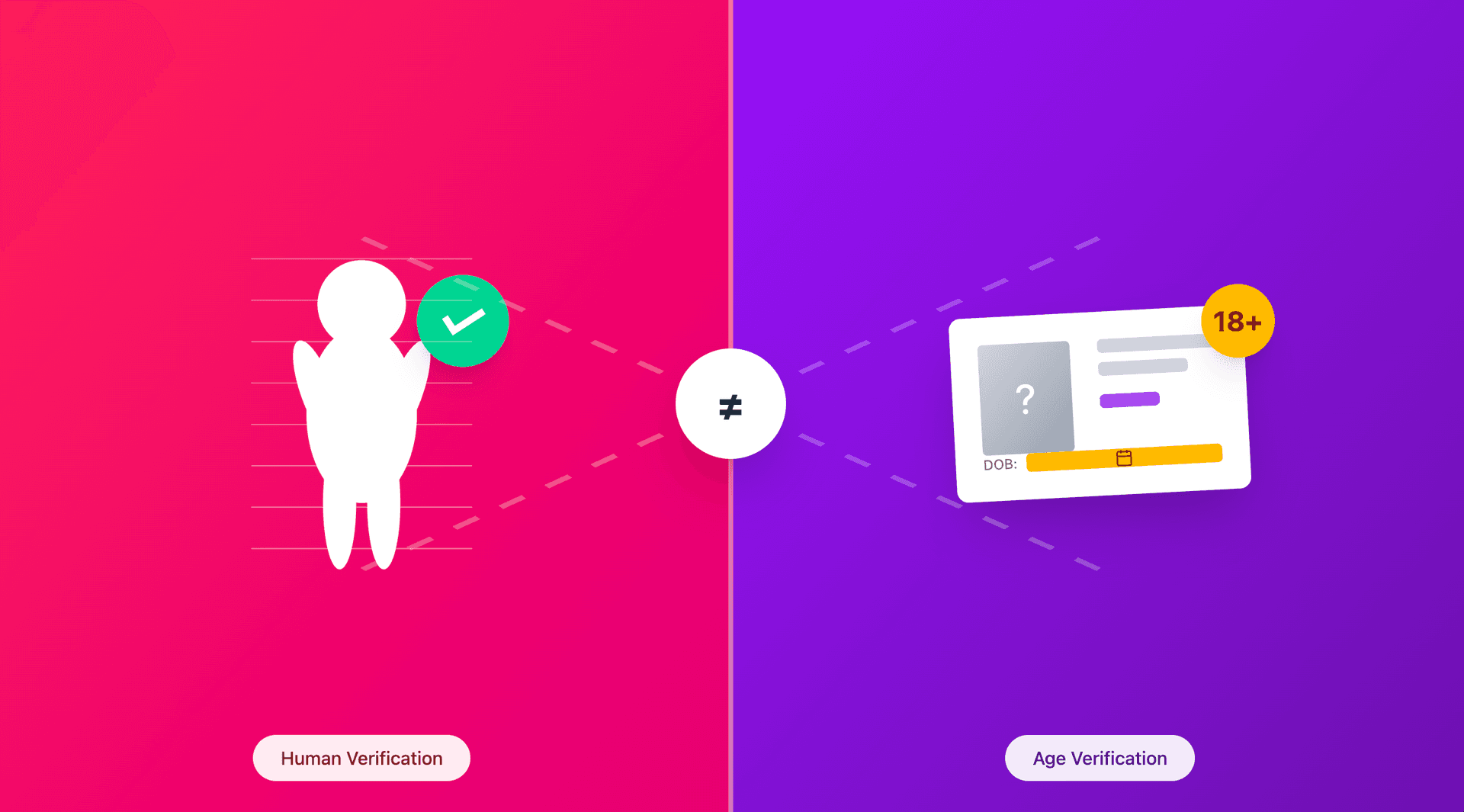
Human Verification vs. Age Verification: They're Solving Different Problems
Two different questions, two different tools. Conflating them is how you end up with bad policy, annoyed users, and a pile of government IDs stored somewhere you'd rather not think about.
Read the post
Blog
Verification: A Field Guide to Doing It Right (and Very, Very Wrong)
What a 269-check age verification tool and an AI company's standoff with the Department of War taught us about where the industry is headed.
Read the postFAQ
Can it check age, gender or location?
Yes. The same selfie can return an estimated age range and an estimated gender, and you choose which signals to collect.
See the answerVerifyYou scales trust: passive signals on every session, a face check only when risk calls for it.
We use cookies. Privacy