Banned users stay banned.
Repeat offender signal
If a person has been flagged elsewhere in our network, you get an anonymous signal before they reach you, and we never say which platform.
Someone removed from your service can walk straight onto another one, with nothing to warn either side.
The first time someone signs up, you have nothing on them, even if another platform already flagged them.
Without an early signal from elsewhere, the first sign of a known bad actor is often the fraud they commit on you.
01
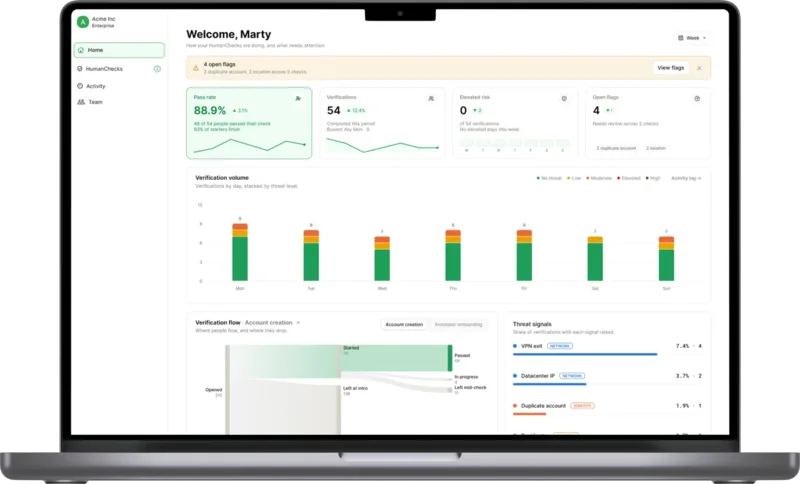
Network, device and behavior signals score every visit and build a history, on your own platform.
02
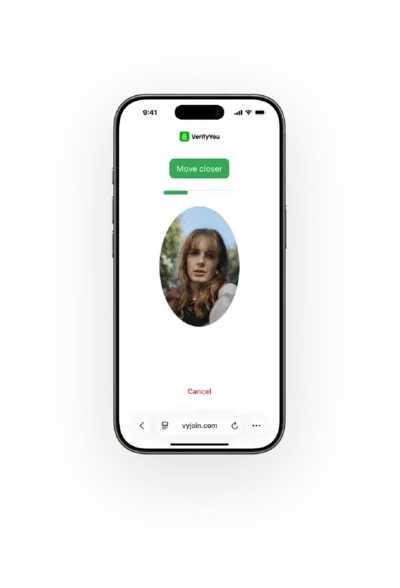
When the signals flag risk, a selfie of about 3 seconds confirms a live, unique human, with no ID.
03
If that same person has been flagged elsewhere in our network, you get an anonymous signal before they can do the same thing to you. We never say which platform.
Start with a free pilot: see what the check catches on your own users, with no dev work to begin.
With tools like VerifyYou, AI becomes a force for good. It helps prevent AI-driven fraud and can be done with much lower friction than what we built over the years.
Built by humans from
We keep a face code, not the photo, and hold it under SOC 2 Type II and ISO 27001:2022 compliant controls.
No images stored. VerifyYou does not store images.
No ID or documents. HumanCheck anonymously confirms there is a real, live, unique person, with no name or ID.
A face code, not a photo. We treat it as sensitive biometric data.
 SOC 2 Type II
 ISO 27001:2022
 ISO/IEC 30107-3 PAD Level 1 & 2
 GDPR compliant
You get a flag that a person was flagged elsewhere in our network, and nothing more. We never say which platform flagged them or what happened there.
No. A network flag carries no detail from the platform that raised it: we never say which platform, and you never see another company's users or data.
Uniqueness is judged inside your own user base: the same face showing up twice in your accounts. The network signal is separate: an anonymous flag that a person was flagged on another platform in our network, and it never names the platform.
It shows up in Flags with the other people your checks caught, and your team decides what to do: let them through, re-check them, or hold them for review.
No. We keep a face code, not your users' images.
It's two API calls: one to start the check and one to read the result.
No. It sits on top of your stack, so you keep your KYC and bot tools.
It's 50 to 100 times cheaper than KYC. You pay per check, and nobody uploads an ID document.

Blog
The Best Human Verification Platforms in 2026
Human verification covers four different product categories that solve four different problems. This guide separates them, compares what each one confirms, and shows which published prices vendors actually disclose.
Read the post
Blog
Sybil Attacks in AI Data Labeling: How Platforms Prevent Them in 2026
How one person running many annotator accounts distorts training data, how the major labeling platforms defend against it today, and how the tools built to stop it compare.
Read the post
Blog
The Most Expensive Part of an Odyssey Ticket Is the Missing Verification
The Odyssey sold out every IMAX 70mm screening in New York, and the resale chaos that followed shows what happens when scarcity meets anonymity.
Read the postVerifyYou scales trust: passive signals on every session, a face check only when risk calls for it.
We use cookies. Privacy