In December 2025 the FTC sent warning letters to 10 companies under its Consumer Review Rule, which bans reviews that misrepresent whether the reviewer used the product at all. Violations can bring civil penalties of up to $53,088 each.
Federal Trade Commission, press release "FTC Warns 10 Companies About Possible Violations of the Agency's New Consumer Review Rule", 22 December 2025Marketplaces
A suspended seller relists by lunch.The new shop still matches the old face.
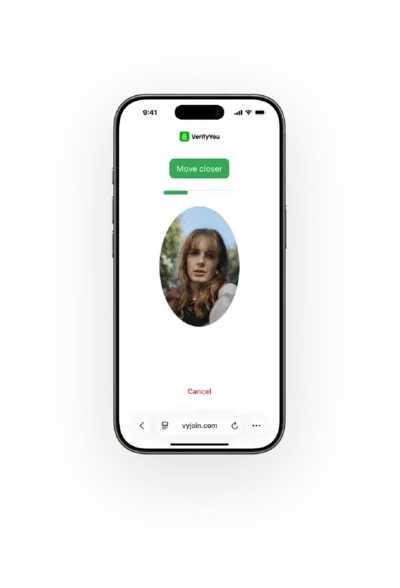
Passive signals check every seller and buyer, and a 3 second selfie, only when they flag risk, confirms a live, unique person with no ID.
The problem
How marketplaces get gamed
- Same sellerSuspended shopNew shop
Fake sellers return
A suspended seller opens a fresh shop with a new email, a new card and a new device, and lists the same stock.
- New review5 starPosted just now12344 accountsOne voice
Review stuffing
One person posts five-star reviews from a ring of accounts, each one looking like a different happy customer.
- 40 accounts6 same person
Promo abuse
Every new account gets the welcome offer, so one person collects it again and again under different emails.
What changes
One account per seller, and the right person gets paid.
01
Passive signals score every seller and buyer
Network, device and behavior signals run in the background of every session, and flag a new shop that looks like an old one.
02
Risky accounts take an anonymous face check
When the signals flag risk, a 3 second selfie confirms a live, unique person before the first listing goes up. Sellers the signals pass never see it.
03
A check before the payout, not after
A pre-payout face check confirms the person about to be paid is the same person who opened the shop, before the money moves.
New shopLooks like it's been here beforeElevated
The platform
Passive defenses first, proof of human when it counts.
Why now
Fake reviews now carry fines
Put the check on new seller sign-ups and on payouts. A free pilot shows you how many seller accounts share one face, and how many payouts were headed to someone other than the person who opened the shop.





A solution for every scenario
Let's talk trust
Start with a free pilot: see what the check catches on your own users, with no dev work to begin.
With tools like VerifyYou, AI becomes a force for good. It helps prevent AI-driven fraud and can be done with much lower friction than what we built over the years.
Built by humans from
- Quora
- Square
- Gusto
- Cohere Health
- Accenture
Security
Privacy and security in every decision
We keep a face code, not the photo, and hold it under SOC 2 Type II and ISO 27001:2022 compliant controls.
No images stored. VerifyYou does not store images.
No ID or documents. HumanCheck anonymously confirms there is a real, live, unique person, with no name or ID.
A face code, not a photo. We treat it as sensitive biometric data.
 SOC 2 Type II
 ISO 27001:2022
 ISO/IEC 30107-3 PAD Level 1 & 2
 GDPR compliant
Common questions
Will buyers and sellers drop off?
You decide who sees the check and when: at the first listing, in front of an offer, at payout, or only for accounts your signals flag, so most people browse and buy without seeing it. Each person sees what's shared before they start. VerifyYou does not store images; we keep a face code, a template made from the face, instead. A free pilot lets you measure drop-off on your own traffic.
Can we check the sellers we already have?
Yes. Email invites to your existing sellers are in beta, or you can put the check on their next payout so it reaches every active seller.
Does this stop fake reviews from posting at all?
Put an anonymous HumanCheck in front of reviews and it confirms the reviewer is a live, unique person before the review posts, which breaks up a ring of accounts run by one person. It doesn't judge whether the review reflects a real purchase, so keep your content moderation for that.
What happens to a suspended seller's new shop?
Their face code, a template made from the face, stays on record anonymously. The next shop they open, on a new email, card and device, matches it at signup, and you choose whether that's blocked or let through and flagged.
Can it catch a promo abuser across more than one offer?
Scope uniqueness to a single offer and each person redeems it once, however many emails they hold. Scope it to your whole account base and the same check follows them across every offer you run.
What if a seller has someone else verify for them?
One handoff can pass on its own. At any real scale it can't: each new shop needs a new device, a new phone number, and has to clear every other signal too, every time. An ID-based check carries the identical weakness, since anyone willing to hand over a device would just as easily hand over an ID.
Do you store photos of our users?
No. We keep a face code, not your users' images.
How much work is it to add?
It's two API calls: one to start the check and one to read the result.
Do we have to replace our KYC or bot tools?
No. It sits on top of your stack, so you keep your KYC and bot tools.
What does it cost?
It's 50 to 100 times cheaper than KYC. You pay per check, and nobody uploads an ID document.
Resources
Keep learning

Blog
The Bots Inside the Front Door: E-Commerce
Carding attacks, phantom customer signups, and the moment the Shopify fraud calendar quietly broke
Read the post
Blog
The Best Human Verification Platforms in 2026
Human verification covers four different product categories that solve four different problems. This guide separates them, compares what each one confirms, and shows which published prices vendors actually disclose.
Read the post
Blog
Sybil Attacks in AI Data Labeling: How Platforms Prevent Them in 2026
How one person running many annotator accounts distorts training data, how the major labeling platforms defend against it today, and how the tools built to stop it compare.
Read the post
Ready to get started?
VerifyYou scales trust: passive signals on every session, a face check only when risk calls for it.