Market Research ·
Your Fraud Check Is Blocking Your Most Valuable Participants
Senior B2B participants work behind corporate networks and managed laptops, which can look like fraud to a passive check. A live check on the person keeps them in the study.
Ammar Khan

An expert network we work with recently recruited senior finance and IT directors for a client's survey. The client runs a passive fraud tool at the survey entrance, and when the directors clicked the link, that tool turned away every one of them. To test the link, the recruiter sent it to a student in Boston and a dentist in Kentucky, and both of them went straight into the survey.
The client kept its threshold where it was, so the study lost the exact people it had paid to reach. The recruiter was left explaining to senior executives why the survey they had made time for would not let them in.
Why the most careful setups look like fraud
Passive fraud tools score the connection and the device. They check whether traffic arrives through a VPN, a proxy or a data center address, and whether the browser shows signs of tampering or automation. We have not seen which signals fired on this project, so what follows is the likely cause rather than a confirmed one.
Large companies route their staff's web traffic through a corporate VPN or a cloud security gateway, which means a director's connection reaches the survey from the security provider's data center instead of from a home network. Zscaler, one of the largest of those providers, explains on its own blog that websites see the data center's address and location, and that sites filtering by location end up blocking that traffic. When a batch of directors arrives from the same data center range in the same afternoon, a passive score can read it as a bot farm.
The laptops add to it. IT departments manage work machines with security software, browser policies and blocking extensions, and each of those changes what the browser reports. A passive tool can read those changes as a tampered device or as automation. The student and the dentist were on home Wi-Fi with personal devices, so their sessions looked ordinary.
The people with the most locked-down setups are usually the senior, hard-to-reach participants a B2B study is built around. The environment a careful company builds for its staff ends up resembling the one a fraudster builds to hide.
A blocked expert costs far more than a missed response
Reaching a senior decision-maker is slow and expensive, because these people have little spare time and a small survey incentive means almost nothing to them. A CFO earning about $240 an hour has little reason to take a $10 survey, as Greenbook laid out, so every director who does agree represents real recruiting effort and a relationship the recruiter worked to build.
Recruiters we talk to describe what happens after a block. The expert who was turned away loses trust in the recruiter and rarely accepts the next invitation, so one false positive costs the current study and the panel's future studies along with it.
Passive scores also vary from tool to tool. A recruiter who ran the same survey through two different passive vendors told us the results came back significantly different, which is what you would expect from a probabilistic read of a device and a network.
Treat the passive score as a prompt and check the person
Passive signals are useful information, and they work best as a reason to take a closer look. A live check answers the question the passive score can only estimate, which is whether a real, unique person is the one taking the survey. In HumanCheck, your configuration decides the outcome: "Your configuration decides whether they passed or failed. The score does not." A corporate VPN can lower a trust score, and the client still chooses what happens next.
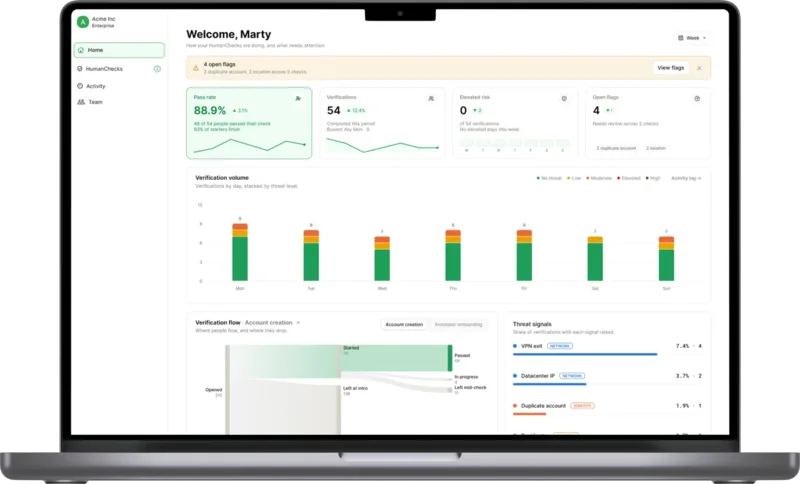
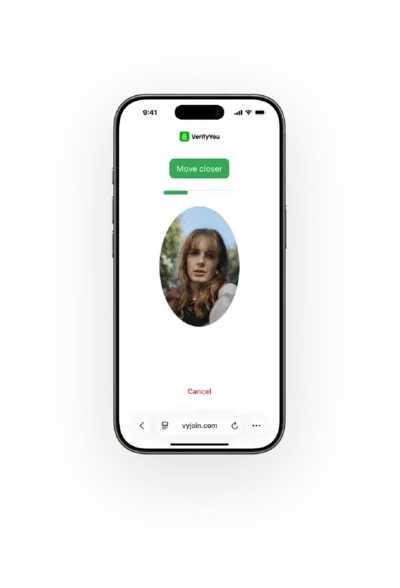
HumanCheck confirms a real, unique human in seconds. Nobody uploads a document and nobody hands personal information to the platform, and the client receives an anonymous confirmation plus an audit trail it can show its own client. Your screener and your recruiters still confirm the job title, and HumanCheck confirms that a real, unique person is the one answering.
Three ways to keep senior participants in the study
Start by confirming experts before they get the link. Run HumanCheck when an expert accepts the project, and then the client can allow-list those confirmed people or give that sample its own link, so a confirmed director goes straight into the survey.
For a longer-term setup, send anyone the passive tool flags to a HumanCheck instead of the terminate page. A pass takes them into the survey. The client keeps its passive tool and learns how many of the people it would have blocked were real.
To diagnose a live project, ask a couple of the blocked participants to open the link on their phone with Wi-Fi off. If they get in, the corporate network is what the passive tool reacted to, and the client has the evidence it needs to change how flags are handled.
Senior participants are the hardest people in research to recruit, and they deserve a front door that recognizes them. See how HumanCheck works for expert networks, or read why every extra step costs you a respondent.