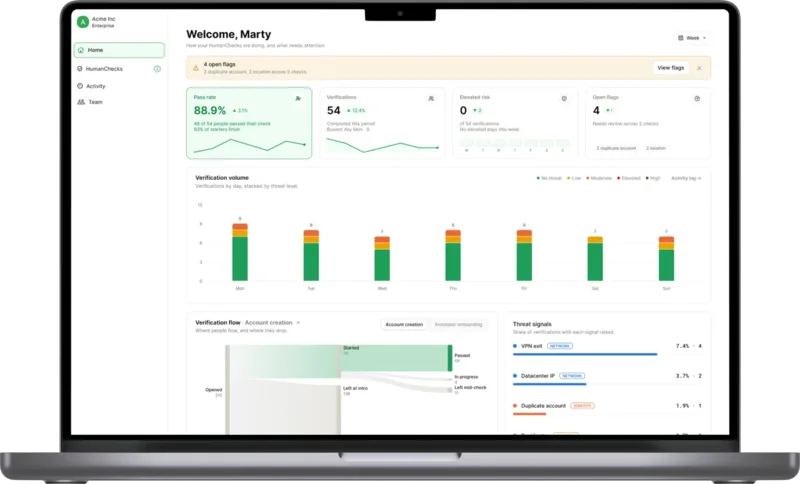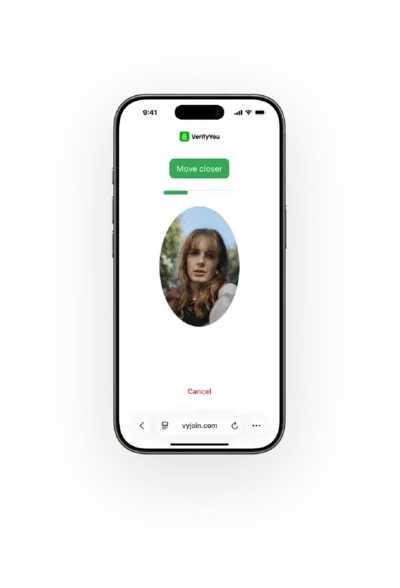
AgentCheck lets a site accept agents while keeping control of what they do. It identifies which visits are agents. The site chooses which actions an agent can take on its own and which need a person's approval, such as accessing a quote, downloading a file, submitting an application or checking out. When an agent reaches one of those actions, an anonymous HumanCheck confirms that a real, unique person approved it, and every check and approval is recorded. Visa Trusted Agent Protocol, Google's AP2, Stripe and OpenAI's Agentic Commerce Protocol and the Personal Agent Protocol cover which agent is acting and its delegated authorization. AgentCheck adds human-in-the-loop approval of the one action, so it's proof of agent at the point of action, part of what the industry calls Know Your Agent (KYA).
AI agents now act for people online.Let them in, on your terms.
Websites want the sales, sign-ups and bookings agents bring. AgentCheck lets a site accept agents while keeping control of what they do. It's our proof of agent product.
Agents bring the business, and the risk.
AI agents now act for people online: they sign up, buy, book, apply and post. Websites want the sales, sign-ups and bookings agents bring. But an agent, or someone running many of them for profit or abuse, can pull out content and data without the visit or sale that pays for it, take actions the site restricts, claim more than one person's share, or take actions the person later disputes. Blocking every agent loses the business, and allowing every agent leaves the site exposed.
- Agent visitPages read240Quotes pulled38Sale or referralNone
Value taken, nothing paid
An agent extracts your prices, quotes or content and leaves without the visit, subscription or sale that pays for them.
- Limited drop, 1 per personA1Agent 1ClaimedA2Agent 2ClaimedA3Agent 3ClaimedBehind themSame person
More than one person's share
One person running many agents claims the limited drop, the sign-up bonus or the vote many times over. That's multi-accounting: one person posing as many customers.
- Order, $900Placed byShopping agentPerson approvedNo recordCustomerDisputed
Actions the person disputes
A purchase, an application or a public comment the person later disputes, with no record of what they approved. Some of it is friendly fraud: a real customer disputing a purchase they did make.
Control the agents, confirm the person, keep the audit trail
01
Control what agents can do
Install the pixel and detection sorts every visit into people, signed or verified agents (which identify themselves) and undeclared ones (which act like a person's browser). Then set an agent trust policy for each action: allow agents, require human-in-the-loop approval (a person confirms that one action), or block.
02
Confirm a real, unique person approved it
At a gated action, the agent's person gives human-in-the-loop approval. The first time it's an anonymous HumanCheck, about 3 seconds and no ID. After that it's a push approval, a single tap.
03
Keep an audit trail
Every gated action is recorded: which agent acted, whether a verified person approved it, what was approved and when. It's your evidence when a transaction is disputed or charged back.
Agent protocols cover the agent. AgentCheck covers the person behind it.
AgentCheck runs on the same platform.






A solution for every scenario
Let's talk trust
Start with a free pilot: see what the check catches on your own users, with no dev work to begin.
With tools like VerifyYou, AI becomes a force for good. It helps prevent AI-driven fraud and can be done with much lower friction than what we built over the years.
Built by humans from
- Quora
- Square
- Gusto
- Cohere Health
- Accenture
Privacy and security in every decision
We keep a face code, not the photo, and hold it under SOC 2 Type II and ISO 27001:2022 compliant controls.
No images stored. VerifyYou does not store images.
No ID or documents. HumanCheck anonymously confirms there is a real, live, unique person, with no name or ID.
A face code, not a photo. We treat it as sensitive biometric data.
 SOC 2 Type II
 ISO 27001:2022
 ISO/IEC 30107-3 PAD Level 1 & 2
 GDPR compliant
Common questions
Is AgentCheck available now?
Not yet for everyone. We're building AgentCheck with a small group of design partners, and you can join the design partner program to put it on your site first.
What can sites and agents do with AgentCheck?
- Sites see their agentic traffic, the visits AI agents make: people, signed or verified agents that identify themselves, and undeclared agents that act like a person's browser.
- Sites set an agent trust policy for each action: allow agents, require human-in-the-loop approval, or block.
- Sites keep one-per-person limits working against multi-accounting, so promos, free trials, sign-up bonuses, ticket caps, votes and drops count people.
- Sites stop ban evasion, because a ban lands on the person whatever agent, email or key they come back with.
- Sites add age assurance to age-restricted actions, an estimated 18+ for the person behind the agent.
- Sites keep an audit trail of every gated action for disputes, chargebacks and compliance.
- Sites monetize the agent traffic real customers send, where a blanket block would turn it away.
Agents and the people behind them get through gated actions with human-in-the-loop approval, become human-backed agents (proof of unique human, without sharing who that person is), and approve later actions with a single tap.
Where does AgentCheck fit?
- Agentic commerce: when agents shop for people, one can extract prices or quotes without the sale or referral that pays for them, or buy something its customer later disputes. Gating quotes and checkout puts a person's approval behind both.
- Retail and drops: an agent buys for its person, and one-per-person limits hold on limited items.
- Ticketing: agents join a presale, and each fan gets one shot.
- Travel and booking: the agent searches and holds a seat, and its person approves the booking.
- Insurance and financial applications: the agent fills in the quote or application, and its person approves the submit.
- Marketplaces: a banned seller can't come back behind a new agent, so ban evasion stops.
- Petitions and public comment: an agent submits for its person, and each person counts once.
- Communities and reviews: one person running many agents still counts as one voice.
- AI platforms: one real person stands behind each account that runs agents, so every agent is human-backed.
Agentic commerce is the clearest case, and the same gate works anywhere an AI agent acts for a person.
Why does this matter now?
Agentic traffic, the visits AI agents make, is climbing fast. DataDome's AI Traffic Report for the second quarter of 2026 counted 17.7 billion AI agent requests on its network, up 45% from the first quarter, and 54% of its customers had set agent trust policies.
Is AgentCheck bot blocking?
No. AgentCheck is for AI agents acting for a real person, signing up, buying or applying on their behalf, and it proves that person is behind them. Bots posing as people are what passive signals and HumanCheck already catch.
What do these terms mean?
- Proof of agent: proof that a real, unique person stands behind an agent and approved what it's doing. AgentCheck delivers it at the point of action, the action itself.
- Know Your Agent (KYA): the industry's term for the category, knowing which AI agent is acting and whether a real person stands behind it.
- Agentic traffic: visits made by AI agents. Agentic commerce: agents shopping and paying for people.
- Signed or verified agent: an agent that identifies itself, with a signed request (standards like Web Bot Auth and Visa Trusted Agent Protocol) or a known user agent. Undeclared agent: one that acts like a person's browser.
- Agent trust policy: the rule you set for each action on your site: allow agents, require human-in-the-loop approval, or block.
- Gated action: an action that needs human-in-the-loop approval, like a checkout over a set amount, a quote, a download or a form submit.
- Delegated authorization: what a person allowed their agent to do in general (AP2 calls these mandates). Human-in-the-loop approval: a person confirming one specific action.
- Push approval: after the first anonymous HumanCheck, each later approval is a one-tap confirmation on the person's phone.
- Human-backed agent: an agent with a verified, real, unique person behind it. Proof of unique human: the anonymous check that one live person, not a duplicate, is there.
- One-per-person limits: caps that count people, not accounts. Multi-accounting: one person posing as many customers. Ban evasion: a banned person coming back under a new agent, email or key.
- Audit trail: the record of each gated action: which agent, whether a verified person approved it, what was approved and when.
- Friendly fraud: a real customer disputing a purchase they did make.
- Age assurance: an estimated age range, such as 18+, before an age-restricted action.
Proof of human is our anonymous HumanCheck: one live, unique person, with no ID. Proof of agent carries it over to the agents people send.
Does AgentCheck work with Visa Trusted Agent Protocol, AP2 and ACP?
Yes, it sits beside them. Visa Trusted Agent Protocol, Google's AP2, the Agentic Commerce Protocol from Stripe and OpenAI, and the Personal Agent Protocol cover the agent and its delegated authorization, what its person allowed it to do in general (AP2 calls these mandates). AgentCheck adds human-in-the-loop approval: a real, unique person confirming the one action at your gate. It plugs in beside them, or runs on its own.
Which agents can it detect?
Signed or verified agents identify themselves, with signed requests through standards like Web Bot Auth or Visa Trusted Agent Protocol, or a known user agent, and are recognized by name. Undeclared agents act like a person's browser, and the same passive signals that run on every visit flag them. Detection is strongest on multi-step flows like checkout and forms, where an agent has to take several actions in a row.
Which actions can we gate?
Any you choose. You set an agent trust policy for each one: allow agents, require human-in-the-loop approval, or block. Gated actions are the ones that need approval, like a checkout over a set amount, a quote, a download or a form submit, and age assurance can ask for an estimated 18+ on age-restricted items. One switch blocks every agent. Browsing and everything you leave open carry on as they do today.
Do you learn who the person is?
No. You learn that a verified person stands behind the agent and what they approved. Their name, face and personal details never reach you.
How do we set it up?
Install the pixel, then set your agent trust policies. Give us your site's address and we map its pages and actions, ask what you're worried agents will do, and recommend which actions to gate for you to confirm one by one.
What's in the audit trail?
Every gated action: which agent acted, whether a verified person approved it, what was approved and when. It's your evidence in disputes and chargebacks, including friendly fraud.
Do you store photos of our users?
No. We keep a face code, not your users' images.
How much work is it to add?
It's two API calls: one to start the check and one to read the result.
Do we have to replace our KYC or bot tools?
No. It sits on top of your stack, so you keep your KYC and bot tools.
What does it cost?
It's 50 to 100 times cheaper than KYC. You pay per check, and nobody uploads an ID document.
Keep learning

Blog
How to Stop Ban Evaders From Rejoining Your Platform
Bans attached to accounts, emails, phone numbers and devices expire the moment an evader resets them. A ban attached to a verified person survives the reset, and that changes what enforcement can actually hold.
Read the post
Blog
The Account Passed Every Check. The Person Doing the Work Never Took One.
AI training accounts now change hands for cash, and platforms that watch contributors harder face legal pushback. The fix is checking the person at the moments that matter.
Read the post
Blog
The Best Human Verification Platforms in 2026
Human verification covers four different product categories that solve four different problems. This guide separates them, compares what each one confirms, and shows which published prices vendors actually disclose.
Read the post
Ready to get started?
VerifyYou scales trust: passive signals on every session, a face check only when risk calls for it.